Houston serves as an excellent model for moving away from fossil fuels and nuclear power to a genuinely clean, infinitely renewable approach to meeting a major city's energy needs.
Saturday, April 09, 2011
Friday, March 04, 2011
Designers find ways to tap wind power almost anywhere

A gizmag post, Power Flowers to domesticate wind turbines, explores the potential of the product of a Dutch design house, Nl Architects, to tap wind power closer to where it is needed.
While most of us will offer strong vocal backing for the construction of wind farms, that can soon change if someone suggests building one nearby. As a result, the tri-blade towers get exiled to the middle of nowhere – or even further away. Instead of having a few high performance giants scattered throughout the land, NL Architects proposes a structure that would bring a few less efficient turbines together and place them closer to the users of the power they generate.
The efficiency of the vertical-axis turbines used in this design is less than tri-bladed turbines, but more can be situated in a given location. The technology looks promising and deserves more investigation.


Friday, February 11, 2011
Smart meters encounter resistance in CA
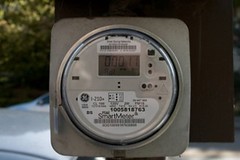
Smarten up, people, urges a post in The TerraPass Footprint. Numerous consumers are balking at the smart meter installations the California utility, PG&E, is rolling out across the state. Privacy and electromagnetic sensitivity are two of the issues being cited by consumers. If a significant proportion of utility customers choose to opt-out, the value of the entire program—which can provide useful minute-by-minute information about electricity usage—can be significantly lessened.
The post's author, Erik Blachford, comments:
For those who aren’t familiar with the smart meters, the basic idea is to replace analog meters read by hand (er, by eye), with digital meters which transmit electricity usage information wirelessly and presumably more accurately back to the utility. This technology enables but does not automatically trigger a variety of new rate-setting possibilities, most notably time-of-day pricing. By the same token, it enables the utility to provide consumers with more detailed information about their energy use; this data can be helpful for consumers hoping to reduce their consumption or even just their bills (though there are other services which don’t involve smart meters which achieve some of the same goals). Finally, smart meters may eventually tie back into the smart grid, allowing utilities to manage power distribution better by optimizing power available from small, distributed energy sources.
The trade-off between individual rights and the greater good of the commons (through a more efficient energy distribution network that can accommodate micropower installations more easily) is a tough one. In this case, the greater good may be on the side of smart metering.
Monday, January 03, 2011
Why buy an electric vehicle? Consumers speak out . . .
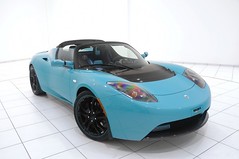
With a growing number of electric vehicles (EVs) reaching the market, consumer preferences are being scrutinized in a serious way. A recent Web survey conducted by ZPryme Research and Consulting—as discussed in a Gizmag article—revealed what it might take to lure a future car buyer away from a fossil-fueled macine to an EV.
As might be expected, range and charging time were key concerns:
Within the very to somewhat likely within two to five years group, 33.7 percent said that 400 miles (644 km) would be a sufficient range, while 33.3 percent were willing to settle for 300 miles (483 km). When it came to acceptable charge times, 32.1 percent indicated 4 hours, 18.1 percent indicated 6 hours, and 20.0 percent would wait for 8. If it were possible to pay a premium to charge their cars faster, 87.4 percent said they would opt for it. The ability to charge one’s EV at home is also a big deal, with 93.2 percent describing it as very important.
The technology is getting there, but meeting some of these consumer demands is going to take some work and some of that work involves consumer education.
Saturday, December 11, 2010
A city powered by waste
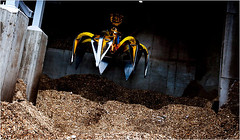
Kristianstad, Sweden is setting an example for the rest of the world, as highlighted in this NY Times article, Using Waste, Swedish City Cuts Its Fossil Fuel Use. After a ten-year effort, the city of 80,000 has cut off the use of oil, natural gas, and coal for heating and now relies on waste products from farming and food processing to generate biogas.
hulking 10-year-old plant on the outskirts of Kristianstad uses a biological process to transform the detritus into biogas, a form of methane. That gas is burned to create heat and electricity, or is refined as a fuel for cars.
Once the city fathers got into the habit of harnessing power locally, they saw fuel everywhere: Kristianstad also burns gas emanating from an old landfill and sewage ponds, as well as wood waste from flooring factories and tree prunings.
Though the lock on fossil fuel use in the U.S. appears to be unbreakable, sometimes workable solutions to our energy problems are right in front of our noses.
Tuesday, November 30, 2010
Triac is not Tesla, but it's not meant to be
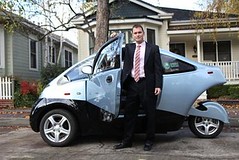
Tesla may have the celebrity cachet and media spotlight, but the humble, three-wheeled Triac is clearly the more practical choice for a "Green Core" consumer looking for a $25,000, all-electric vehicle with an honest 100-mile range. In a siliconvalley.com article, Mike Ryan, president of the firm based in Salinas, CA that produces the Triac, says that the car is aimed at people who have a more environmentally conscious lifestyle.
Key among the features is a sophisticated system for predicting remaining range before a recharge is needed.
The Triac will include a Vehicle Efficiency Data Assistant -- VEDA -- interface to the battery management system as well as diagnostic and navigational data. VEDA is an electronic learning system that captures a person's driving habits and commute patterns to accurately predict miles left before recharging.
"Range anxiety is something that gives people a lot of concern," Ryan said. "Say I forgot to charge my car. I'm at lunch. I want to run an errand before I go home. Will I make it home?"
Options in the electric car market are getting more expansive. The Triac is an interesting home-grown option that favors practicality over panache—and for many buyers that's a plus.
Thursday, November 25, 2010
Sahara Solar Breeder Project to turn sand to solar cells to electricity
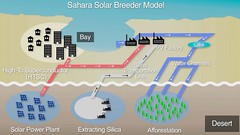
An ambitious project sponsored by universities in Janpan and Algeria seeks to accelerate the production of energy from solar cell technology using silica and sunlight from the Sahara Desert. The objective is to first extract silica from the sand to create solar panels and then combine the panels to make solar power plants in the same geographic area. The plants would be used to power additional silica extraction and solar cell manufacturing, building exponentially on the energy potential with a target of providing 50 percent of the world's energy by 2050.
As detailed in a Gizmag.com article, the project is attempting to accomplish a number of things that haven't been done before.
Subscribing to the "give a man a fish and he eats for a day, but teach a man to fish and you feed him for a lifetime" philosophy, another major aim of the project is to train scientists and engineers from developing countries. To that end, the project won’t just bring well-understood technology from developed countries, but will involve people from both developing and developed countries working together on R&D right from the outset.
“Because technology hasn't yet been established for making silicon from desert sand, then using it to make solar cells, our aim is to work together from the basic research stage, so we can discover and nurture talented scientists and engineers in Africa," said Koinuma.
More power to this project and a sincere hope that they meet their objectives.
Wednesday, November 17, 2010
Climate change deniers take over the House

Hopenhagen
Originally uploaded by Bjørn Giesenbauer
Elizabeth Kolbert's Field Notes from a Catastrophe tackled the challenge of global warming as a first-person observer, traveling around the world to witness the changes in places where they are most severe. Now, writing for The New Yorker in Uncomfortable Climate, she takes a hard look at the current crop of deniers entering the US House of Representatives, many of whom consider their primary role as disrupting any hope of political progress on this critically important global problem.
Though four presidents in succession have paid lip service to preventing dangerous climate change, these commitments haven't lead to any significant action given the magnitude of the challenge.
Elizabeth sums up the current situation neatly:
Meanwhile, as John Boehner chortles about the dangers of CO2, the world keeps heating up. According to the National Oceanic and Atmospheric Administration, the first half of 2010 was the warmest January to July on record. And this is just the beginning. Owing to the inertia of the climate system, the warming that we’re experiencing is only a fraction of the temperature increase that’s already guaranteed.
The United States is no longer the world’s largest carbon emitter; that honor belongs to China. But we’re still the largest source of warming in terms of cumulative emissions, and on a per-capita basis Americans produce more CO2 than just about anyone except the Qataris. Without the active support of the United States, there’s no way to make progress on emissions globally. This month, negotiators will meet in Cancún for another round of international climate talks, and it’s a safe bet that, apart from the usual expressions of despair, nothing will come of them. It may seem that we’ll just keep going around and around on climate change forever. Unfortunately, that’s not the case: one day, perhaps not very long from now, the situation will spin out of our control.
The window left for action is closing quickly. If the new members of the House have their way, it will be slammed shut permanently, in blithe ignorance of the consequences.
Sunday, November 07, 2010
Nicaragua adopts aggressive renewable energy targets

La Vieja Managua (Nicaragua)
Originally uploaded by denetsnuff
Nicaragua is setting aggressive targets to replace fossil fuel use with renewable fuels, as discussed in this Renewable Energy Magazine article. Under a plan announced by Emilio Rappaccioli, the Nicaraguan Minister of Energy and Mines, on October 29th, the goal is to increase the use of renewables to 94 percent by 2017 and to be at the 100 percent renewable mark by 2025. Currently, 66 percent of Nicaragua's thermal energy is petroleum based.
If we could get the US to make a similar commitment, we'd be able to make some serious progress toward reversing climate disruption.
Thursday, October 21, 2010
Solar power creates electric grid challenges in Germany
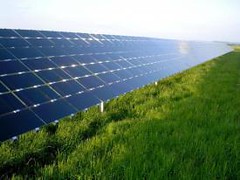
The accelerating adoption of solar panels in Germany looks like a case of too much of a good thing. The antiquated power grid across the country is having trouble coping with the fluctuations resulting from feed-ins from photovoltaic systems and wind turbines.
As reported in this UPI.com news story:
Experts have long called for an overhaul of the European power grid to integrate the fluctuating renewable energy sources such as solar and wind power.
Experts forecast between 8 gigawatts and 10 GW of solar power capacity to be installed this year -- the equivalent of roughly 10 large coal-fired power plants. In 2009, only 4 GW were installed.
With an equally fragmented and outdated power grid, the U.S. would do well to overhaul its own infrastructure in preparation for more extensive use of renewable energy. Google's investment in the Atlantic Wind Connection is a step in the right direction.
Thursday, September 23, 2010
Mini Goes Electric

Another automobile manufacturer, Mini, dips its cast aluminum toe into the electric vehicle market, but this type it's scooter prototypes that appeared at the Paris Motor Show, rather than cars, as profiled by Wired magazine.
Details are scarce. It has an electric motor. You plug it in. But, the prototypes recall classic Italian scooters and Mods versus Rockers schtick.
There are three “interpretations” of the design by Adrian van Hooydonk, senior VP of design for BMW Group. One is a two-seater done up in the same colors (matte charcoal and yellow) as the Mini-E electric prototype. The second is a single-seater Mini calls “almost purist in design.” The third draws on British ’60s pop culture, particularly “the distinctive graphics of the Mod era.”
As a Mini Cooper owner and an admirer of the technology emerging from this BMW Group, it will be interesting to see how this plays out.
Sunday, September 19, 2010
Saab Goes Electric
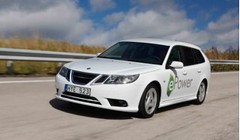
From borderline extinction to a surprising renaissance under the Dutch firm Spyker, Saab may still have some innovative ideas left in its automotive bag of tricks. The company has unveiled its first electric car, an introduction which should help keep alive its reputation as an idiosyncratic but forward-looking auto manufacturer, as reported by AllCarsElectric.
Mats Fägerhag, Executive Director of Vehicle Engineering at Saab Automobile, says that "this program is designed to evaluate the potential for developing a high performance, zero emission electric vehicle and is an important next-step in the extension of our EcoPower propulsion strategy".
Let's hope that this is a positive step toward recovery for a car company that (at least until the GM years) always bristled with personality.
Thursday, September 09, 2010
Real-world road test: life with a plug-in Prius
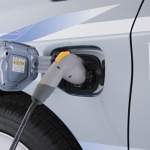
Adam Vaughan puts the new plug-in Prius through its paces in London and its outskirts and discovers that the vehicle is reasonably practical. But clearly more charging points are needed for this type of vehicle. Even in the mighty metropolis of London there are far too few.
Plugged in via the leads in the boot, the electric battery was topped up for free in an hour and a half. While Westfield’s developers deserve credit for installing the points in the first place, they also warrant a raspberry for allowing any car to take the charging spaces – they’re not reserved for electric vehicles.
And here lies the only real drawback to PHEVs: there are not enough places to charge them, even in the urban areas where they’re best-suited. Home-charging, in particular, is tricky in cities because of the lack of driveways and garages. Of course, because you have petrol as a backup, you don’t have to panic about recharging as you would with a 100% electric vehicle. But by not being able to charge out and about, you lose the unique environmental and financial benefits.
It's promising technology if we find smarter ways of generating the energy supplied to the charging points, but that's another problem for another day.
Tuesday, August 31, 2010
Life Cycle Analysis: Electric Vehicles
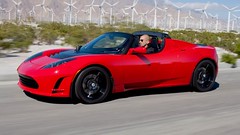
A recent Gizmag article summarized the findings of a life cycle assessment of the lithium-ion batteries often used in electric vehicles. Scientists from the Swiss Federal Laboratories for Materials Testing and Research tracked the environmental footprint of Li-ion batteries, including the charging cycle when tied to a typical European electricity mix, with generally positive findings.
The study shows that the electric car’s Li-ion battery drive is in fact only a moderate environmental burden. At most only 15 per cent of the total burden can be ascribed to the battery (including its manufacture, maintenance and disposal). Half of this figure, that is about 7.5 per cent of the total environmental burden, occurs during the refining and manufacture of the battery’s raw materials, copper and aluminum. The production of the lithium, in the other hand, is responsible for only 2.3 per cent of the total.
“Lithium-ion rechargeable batteries are not as bad as previously assumed,” according to Dominic Notter, coauthor of the study which has just been published in the scientific journal Environmental Science & Technology.
Now if we could just get past the controversy on whether there is a pending lithium shortage, the technology would have a clear path to success.
Sunday, August 22, 2010
Kia set to introduce electric vehicle

The Kia Electric POP (highlighted by Fast Company) hints at the future of electric vehicle design. The tiny three-seater will be on display in October at the Paris auto show. Bring sun glasses.
Sunday, August 08, 2010
Let there be light (and heat)
A new process developed by Stanford engineers--photon-enhanced thermionic emission (PETE, for short)--promises to boost solar power considerably, bringing it within a range to compete with oil.
Watch and judge for yourself.
"This is really a conceptual breakthrough, a new energy conversion process, not just a new material or a slightly different tweak," said Nick Melosh, an assistant professor of materials science and engineering, who led the research group. "It is actually something fundamentally different about how you can harvest energy."
Watch and judge for yourself.
Tuesday, June 15, 2010
RMI's Reinventing Fire initiative launched
If the catastrophe in the Gulf of Mexico makes you want to help move the U.S. to a more sane approach to meeting energy requirements, consider the path that the Rocky Mountain Institute has devised to reshape our thinking and our national priorities on energy issues.
Sunday, June 06, 2010
String rail: a low-cost rail alternative?

String rail, a promising, inexpensive alternative to conventional rail systems profiled by Gizmag, might be a genuine breakthrough in comparion with other forms of high-speed mass transit. With costs estimated to be anywhere from three to 10 less expensive than approaches such as railway or monorail, string rail—originally prototyped by Anatoly Unitsky in Russia—is projected to support top speeds of 220 to 300 mph.
Is this something that could actually happen? The article's author, Loz Blain, notes:
Would I find it a bit freaky to be doing 350 kmh while hanging from a wire? Yes sir. Am I entirely convinced that the strings won't snap, even if a tower or three get taken out? No. Would a full scale demonstration convince me? Probably, yes. And this is the stage Unitsky is stuck at. His demonstration rig is small-scale, and there's nothing like the UST in operation anywhere in the world.
STU Systems in Australia is working to commercialize the concept and, naturally, seeking investors. Does anyone have a few hundred million of seed money to help get a very interesting mass transit approach off the ground?
Thursday, May 27, 2010
Reacting to the Gulf of Mexico Disaster

Even the early NASA photos etched a chilling picture of the scope of the British Petroleum oil spill. The scale of environmental damage is incalculable and even though the outpouring of oil and gas appears to have been at least temporarily stopped, the true cost of this mega-accident won't be known for decades.

The sane response, and the one presented by Senator Bernie Sanders of Vermont, is to immediately launch a nationwide initiative to switch to clean energy. An excerpt from his press release on the subject lays out the simple facts:
The simple truth is that we cannot drill our way to energy independence or lower gas prices. The United States uses roughly 25 percent of the world’s oil, 7.5 billion barrels per year, but we have only 2 to 3 percent of the world’s proven oil reserves. Offshore drilling today provides roughly 10 percent of the oil we use in the United States. While we are all familiar with such political rhetoric, supported by the enormously profitable oil industry, as “drill here, drill now, pay less,” it’s just not accurate. The non-partisan Energy Information Administration has stated that opening new areas for offshore drilling would not save consumers a single penny per gallon until 2020, and would only save about 3 cents per gallon in 2030.
The alternative to continuing to risk catastrophe from offshore drilling is a bold and aggressive move to energy efficiency and sustainable energy. Instead of saving a few pennies on the gallon by 2030 through more drilling, we can save far more with stronger fuel economy standards. Just by raising our fuel efficiency standards to 35.5 miles per gallon for cars and trucks, as President Obama is doing, we will save consumers a dollar per gallon of gas in 2030, and save so much oil that we will no longer need to import any from Saudi Arabia. We know we can do this because new cars sold in China today average more than 36 miles per gallon, and General Motors already sells nearly as many cars in China as in the United States.
If, as a nation, we are prepared to take bold action in energy efficiency, public transportation, advanced vehicle technologies, solar, wind, biomass, and geothermal, we can transform our energy system, clean up our environment, and create millions of new jobs in the process. This direction, and not more offshore drilling, is where we have got to go.
No more new offshore drilling. Not now! Not ever!
Monday, April 19, 2010
Post Peak Oil Two-Wheeled Fun
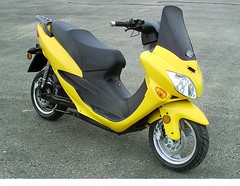
I'm a sucker for two-wheeled vehicles, but I've been discouraged lately from the acquisition of petroleum-powered machines by both the nature of the fuel and the CO2 generation. Bicycles are great, but in a rural area with few bike paths battling autos for a tiny sliver of space on a skinny backroad can get dicey.
The introduction of a new electric scooter, the ZEV7000, as profiled by Gizmag, looks like a healthy way to enjoy two-wheeled travel without the pollution problem.
The battery power specs for this machine, billed as the fastest electric scooter on the market, look pretty good:
Range for the ZEV7000 is similar to the Vectrix at between 55 and 70 miles between charges, which take 25 minutes for a 75 percent top-up, or around 2 hours for a full charge. You can extend the vehicle's range or choose to access higher power by using what the company calls its "electronic transmission" - a switch that lets you choose how many amps the engine is running at. Low amps means low power but extended range, higher amps will drain the battery faster but give the bike substantially more beans.
Put up a wind turbine to recharge it at night and you've got a non-petroleum mode of transport that promises to be a kick and a half to ride.
Subscribe to:
Comments (Atom)