Wednesday, September 10, 2008

Playing Russian Roulette with the Planet

xNASA photo

In an effort to explore the forces that created the universe, scientists at CERN started operation of the Large Hadron Collider (LHC) today, despite concerns from some physicists and cosmologists that the experiments conducted in the LHC could cause reactions leading to the destruction of the planet.

Cosmologist Luis Sancho, who was initially behind the project, commented in Harpers:

Unfortunately, theoretical calculations show that the LHC could produce two kinds of dark matter—black holes and strange, ultradense quark matter—that are extremely dangerous, as both have been theoretically proven to swallow in a chain reaction the entirety of Earth. Thus, a cosmological bomb billions of times more powerful than the atomic bomb might be created at the European Organization for Nuclear Research.

The exact probability of a runaway reaction that converts Earth into dark matter is unknown. The minimal risk as calculated by CERN allows for a 1 to 10 percent chance of extinguishing Earth. In the insurance business, a potential catastrophe’s “death toll” is calculated by multiplying the number of possible victims by the probability that the event will occur. A similar calculation (6,000,000,000 x 1–10%) shows that the LHC experiment would be, technically, the largest holocaust in history. It would also be the biggest environmental crime in history, far more harmful than global warming, as it would mean the destruction of all life-forms on the planet. Since the production of dark matter is neither necessary for the advancement of science nor safe for mankind, the LHC should be forbidden to operate. As we close Chernobyl-like plants for security reasons and forbid the reproduction of the Ebola virus in an open environment (though some specialized virologists would like to study it for research purposes), so should we forbid the reproduction of free, uncontrolled dark matter, even if its theorists would like to study it at CERN. The production of dark matter will not be a “new discovery,” nor will it advance the study of physics. Furthermore, CERN’s researchers will not be awarded a Nobel Prize—the ultimate goal of all experimentalists—if Earth is consumed.


The LHC started without incident today, leading some wag at The Independent to proclaim, You're reading this, so the world hasn't ended.... Of course, the initial startup of the particle accelerator only involves a stream of sub-atomic particles moving in a single direction through the 27-kilometer circular tunnel. The particle collisions begin when they launch a stream in the opposite direction and those collisions are expected to briefly reproduce conditions that existed when the universe was conceived.

Efforts to halt the operation of the LHC through lawsuits until safety concerns are addressed have so far been unsuccessful. The Citizens Against The Large Hadron Collider Web site states:

Some experts fear that the risk of operating the LHC disproportionately outweighs anything science might gain from this experiment. It is not possible to know what the outcome of the experiment will be, but even CERN (the European Organization for Nuclear Research) scientists concede that there is a real possibility of creating destructive theoretical anomalies such as miniature black holes, strangelets and deSitter space transitions. These events have the potential to fundamentally alter matter and destroy our planet.


I wish I could get the image out of my head of a band of arrogant children poking at a hornet's nest with a stick to see what might happen. I'm not persuaded by the reassurances of the career-minded scientists at CERN who routinely dismiss critics at Luddites and yet don't really know what will happen and what the ultimate outcome will be when the particle streams collide in the LHC. That's why it's called an experiment.

Monday, September 08, 2008

Using Wind to Power Cars

electric-car_drum

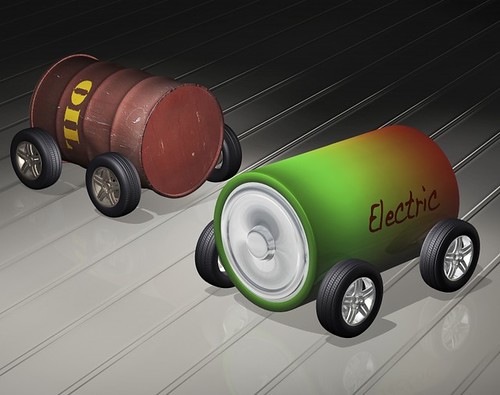
Lester Brown calls T. Boone Pickens to task for pushing natural gas as a vehicle fuel when using wind to recharge electric cars is a much more efficient process (and far easier to implement).

Brown gives Pickens credit for the wind power side of his argument in an opinion piece for The Capital Times, but sees no sense in the natural gas advocacy. In this piece, he asks:

Why not use the wind-generated electricity to power cars directly? Natural gas is still a fossil fuel that emits climate-changing gases when burned.

Plug-in cars are here, nearly ready to market. We just need to put wind in the driver's seat. Several major auto manufacturers, including GM, Ford, Toyota and Nissan, are producing plug-in hybrids. Both Toyota and GM are committed to marketing plug-in hybrids in 2010. Toyota might even try to deliver a plug-in version of its Prius gas-electric hybrid, the bestseller whose U.S. sales match those of all other hybrids combined, next year.

GM is in the game, too, with its Chevrolet Volt. This plug-in car is essentially an electric car with an auxiliary gasoline engine that generates electricity to recharge the batteries when needed. It boasts an all-electric range of 40 miles, more than adequate for most daily driving. GM reports that under typical driving conditions, the Volt averages 151 miles per gallon.


Brown goes on to say:

This new car technology is matched by new wind-turbine technology, setting the stage for an automotive-fuel economy powered largely by cheap wind energy. The Energy Department notes that North Dakota, Kansas and Texas alone have enough wind energy to easily satisfy national electricity needs. To actually put wind power on the road, of course, we would have to tap the wind resources in nearly all the states, plus those that are off-shore, which the department says can meet 70 percent of national electricity needs.


Who is right? I'm inclined to cast my vote in favor of Occam's Razor, or, as it is often paraphrased: All other things being equal, the simplest solution is the best. Wind-powered plug-in hybrids appear to be the simplest solution.

Sunday, August 31, 2008

No Such Thing As Clean Coal

There is no such thing as "clean coal", environmental lawyer Robert F. Kennedy Jr. stated in an interview with the Real News Network. His remarks followed a panel presentation on clean coal that included Dr. Hansen, the NASA scientist who has been warning about the dangers of global warming for a number of years. The consensus is clear and direct: coal is dirty and destructive.


Tuesday, August 19, 2008

Solar Energy Scales to New Levels

solar_in_CA

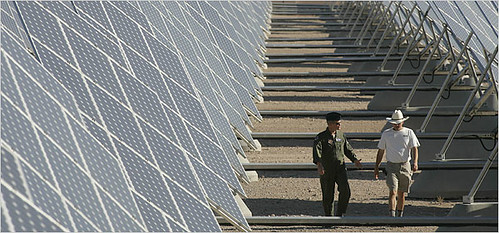
The 14-megawatt solar power installation (shown in the photo) that operates at Nellis Air Force Base in Nevada is about to be upstaged by a planned installation in California with an 800-megawatt capacity.

As the New York Times reports in Two Large Solar Plants Planned in California, the two photovoltaic installations, now being planned for central California, will produce power at a scale equivalent to a small nuclear power plant when the sun is shining brightly. The scale of this project is a clear indication that solar power has reached a new milestone. Pacific Gas & Electric will purchase the power from the two companies behind the installations: Optisolar and SunPower Corporation.

The companies said they were forbidden by contract terms to talk about price, and a spokeswoman for Pacific Gas & Electric said her company was trying to obtain the best possible deal for ratepayers by not telling other suppliers of renewable energy what it was willing to pay.

But all three companies said the costs would be much lower than photovoltaic installations of the past.


To some degree, these two installations are driven by recent mandates legislated in California, requiring energy producers to reach a level of 20 percent renewables by 2010. But, they also serve as a proof-of-concept that solar can generate power at a vastly larger scale than in the past using the latest technologies.


Tuesday, August 05, 2008

Reviving the Lost Arts: Fuel-Sipping Microcars

Avolette Tourisme 1956

The classic expression, "Necessity is the mother of invention", was proven beyond doubt in post-WWII Europe where the severe fuel shortages inspired automakers to create a variety of microcars. Often capable of hitting 70mph and traveling 90 miles on a gallon of fuel, these fuel-efficient wonders were manufactured in volume--perhaps 250,000 were produced in the years following the war.

The auto in the photo, a 1956 Avolette Tourisme, is part of a microcar collection owned by Bruce Weiner (who owes his fortune to Dubble Bubble gum). An entertaining piece by Bo Emerson in the Atlanta Car News talks about Weiner's obsession with these vehicles and charts the history of microcars.

Microcars were created out of necessity. Not only was gasoline at a premium, but manufacturers were short of money and materials. Messerschmitt was banned from building fighter planes and turned out sewing machines and refrigerators.

Entrepreneurs such as Fritz Fend (builder of the F.M.R.), created small shops, then collaborated with larger manufacturers. (Fend built thousands of vehicles in the Messerschmitt factories.) Some microcars were little more than enclosed, three-wheeled motorcycles.

The microcar craze lasted through the mid-1960s; by then European fortunes had risen, and customers demanded cars that could seat a family comfortably.


We had practical electric cars in the early 1900's, as well, phased out as our oil addiction grew by leaps and bounds. Perhaps it's time to revive some of these lost arts and build a new generation of microcars and electric vehicles--the necessity is cleary at hand.

Saturday, August 02, 2008

Storing Solar Energy the Way Plants Do

oxygen-nocera-enlarged

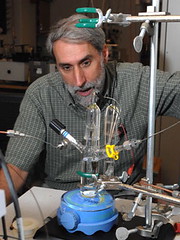
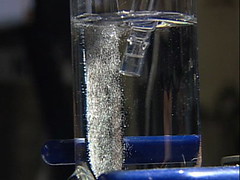
One of the chief complaints about the practicality of solar energy has been: what do you do when the sun isn't shining? MIT researchers have come up with an answer: using a technique similar to that used by plants during photosynthesis. The development of a new catalyst to produce oxygen when an electrical current is passed through water, working in combination with another catalyst that produces hydrogen gas, becomes a powerful mechanism for charging fuel cells. This stored energy can be released as needed, a virtually carbon-free source of electricity that is available day or night.

oxygen-bubbles-enlarged

As quoted in an article for the MIT News by Anne Trafton, Daniel Nocera, the Henry Dreyfus Professor of Energy at MIT, who has co-authored a paper on this discovery for the July 31, 2008 issue of Science, sees this as a landmark advance in energy production.

"This is just the beginning," said Nocera, principal investigator for the Solar Revolution Project funded by the Chesonis Family Foundation and co-Director of the Eni-MIT Solar Frontiers Center. "The scientific community is really going to run with this."

Nocera hopes that within 10 years, homeowners will be able to power their homes in daylight through photovoltaic cells, while using excess solar energy to produce hydrogen and oxygen to power their own household fuel cell. Electricity-by-wire from a central source could be a thing of the past.


Nocera also points out that the amount of sunlight that strikes the Earth in one hour is sufficient to supply the energy needs of the entire planet for a year.

In a video post on the MIT site, Nocera talks more about the potential of this new process.


Sunday, July 27, 2008

Electric Car Infrastructure

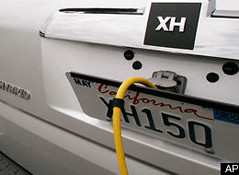
electric_car_plugin

The day is fast approaching when electric cars will be tooling around our city streets and neighborhoods, driven by people other than well-heeled celebrities or devoted hobbyists. As GM and a slate of other automobile manufacturers ready their first serious electric cars for the market, thoughts naturally turn toward the state of the infrastructure for dealing with these electricity sipping vehicles.

Joel Makower in Electric Cars: Where Will the Infrastructure Come From? grapples with some of the issues that are quickly moving from the theoretical realm to the practical.

In reality, the GM-utility conversation isn't entirely new. It began in January, at a Vehicle Electrification Workshop held at GM's research center in Warren, Michigan. I had the privilege of attending the meeting, which was facilitated by my colleagues at the sustainability strategy firm GreenOrder. The meeting included more than two dozen utility executives, including a team from the Electric Power Research Institute, the industry-funded consortium that served as the co-convener of the meeting.

It was an eye-opener, to say the least. It turns out that building the infrastructure for the plug-in electric vehicle isn't simply a matter of, "Here's a plug, here's a socket. End of story."

First of all, not everyone has a socket — a secure place to park their car and recharge it. Those living in apartment buildings, for example, lack this ability. Even where a plug exists, it may not have sufficient amperage to handle the load. (I'm a good example: I have a socket in my garage, but it's on the same circuit as my bedroom. If you plug in a power-hungry appliance in the garage, TiVo gets grumpy.)

But that's the least of it. Building the plug-in infrastructure involves a mind-numbing array of technical challenges.


Makover goes on to talk about connector compatibility, outlet access, vehicle-to-grid considerations, and other topics that make it clear that there is more to this transition away from the petrol pump than just hopping in an electric vehicle and driving away. Now is the time to start setting the standards and creating the infrastructure.

Thursday, July 24, 2008

Fighting Goliath: A Documentary About Coal Plant Battles in Texas


Conventional coal-fired power plants represent one of the most serious threats to human health and a major cause of global warming. This documentary, posted on SnagFilms, provides a revealing look at how a group of mayors, farmers, and ranchers fought a company planning to construct 18 of these power plants in Texas.

Sunday, July 20, 2008

Karoshi and Other Prius Stories

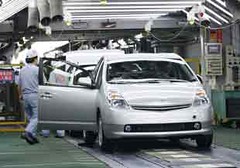
toyo_factory

"Karoshi", a term used by Japanese workers that translates to "overworked to death" was the fate of 30-year old Kenichi Uchino, who collapsed and died at the Prius plant in "Toyota City", Japan. The court in Nagoya ruled the cause of death as exhaustion and noted that in the month leading to his death, Uchino had worked as much as 155 hours overtime, much of it unpaid.

This story and other unsettling details included in a report by the National Labor Committee in New York (NLC) casts a shadow on the labor practices of Toyota, the world's largest automobile manufacturer.

Paul Abowd, who picked up the story for In These Times, noted:

In its 65-page report released in June, NLC includes first-hand testimony of factory conditions in “Toyota City,” outside of Nagoya, Japan — less than 200 miles southwest of Tokyo — where the largest auto company in the world employs some 70,000 people.

The report alleges that Toyota exploits guest workers, mostly shipped in from China and Vietnam. According to the NLC, these workers are “stripped of their passports and often forced to work — including at subcontract plants supplying Toyota — 16 hours a day, seven days a week, while being paid less than half the legal minimum wage.” Workers are forced to live in company dormitories and deported for complaining about poor treatment, the report finds.


Both Abowd and the NLC recognized that Toyota's position in the auto industry hasn't been gained by a multitude of bad practices, but a growing trend toward undercutting the rights of the workforce by systematically lowering wages and introducing harsh work situations for temporary workers is steadily degrading the labor situation worldwide. Even in the U.S., where a middle class was born from comfortable automobile manufacturing jobs, Toyota's temporary worker practices are raising eyebrows.

In a rebuttal to the NLC report, Toyota responded:

Toyota is committed to being a good corporate citizen to all of our stakeholders, including our employees, partners, suppliers and customers. The NLC report contains numerous inaccuracies that present a false and misleading picture of our company. Contrary to the report’s allegations, Toyota respects its employees and honors the basic human rights of the people involved in our business. We comply with all applicable local laws and regulations wherever we operate while providing fair compensation and benefits.


However, many of the specific allegations in the NLC report went unanswered. We hope that Toyota takes its corporate responsibility seriously and addresses these labor issues in a transparent manner. Anyone driving around in a "green" Prius manufactured under questionable conditions should take Toyota to task and demand accountability and fairness for the way workers are treated.

Monday, July 14, 2008

Europe Shows How to Save Energy


vélo sans mains
Originally uploaded by yeuxrouge


With a surfeit of natural resources and an attitude that often views prodigious consumption as a virtue, the United States has lagged behind Europe for many years in terms of energy efficiency. As oil supplies dwindle and SUVs grow rust in the back corners of car lots, the message is finally getting through that our habits need changing and the kinds of changes needed can be seen in examples from Europe, where transportation, heating, cooling, and people-powered vehicles are dramatically different than stateside.


Writing for the Christian Science Monitor, Jerry Lanson explains the ways in which Energy-addicted U.S. can learn a lot from Europe. Among those ways, easy access to bicycles in the cities makes a sizable difference in traffic:

Throughout the city, residents and guests can grab a bike at one location, compliments of what seems a simple credit-card prompted trigger, and return it to any of dozens of other locations. The first half-hour, the instructions noted, is free. Each evening we watched as the streets filled with young and often fashionable bike riders, as likely pedaling in high heels and dress slacks as in jeans and sandals.

None of these measures, of course, have taken the sting out of gas prices twice as high in much of Europe as what Americans are paying for at the pump today. But perhaps if Americans, who still use more energy per person than any country in the world, took note and took action to follow suit, prices here and there might at least stabilize.


Lanson sums up the issue neatly at the end of this article:

So as we grouse at the president, Congress, the oil companies and just about anyone else paying too little heed to our growing pain, perhaps Americans should remember that conservation can – and should – begin both in our homes and in our towns.

Let's think globally, then act locally. Our European friends have been doing that for a long time.

Sunday, July 13, 2008

Beyond the Hype, Solar Power Advances


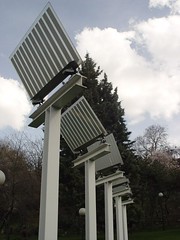
small solar collectors in a line
Originally uploaded by Kel Patolog


The convergence of technology advances and rising fossil fuel prices is bringing the potential of solar power into sharp focus, both literally and figuratively. Discoveries from researchers at MIT promise to boost the efficiency of solar panels by concentrating the sun's rays, a measure that will help bring down the cost of panels considerably.


In a Boston Globe article, Innovation fuels solar power drive, journalist Carolyn Y. Johnson writes of the MIT study:

The work by Mapel and others could potentially do both, by using a simple trick that makes more efficient use of sunlight and uses fewer costly solar cells.

Solar cells are made from different materials that each operate most efficiently when using light from a narrow band of wavelengths. By filtering the light through a pane of glass coated with dye, Mapel and his colleagues have been able to direct some light to solar cells that can use it most efficiently. Those cells are placed on the edge of the pane, requiring far fewer solar cells than if they were placed along the surface as on conventional panels.

The remaining light passes through the pane and, if placed on a conventional solar panel, can be converted to electricity.

The researchers found that their setup increased the efficiency of traditional panels by about 20 percent, but they believe that with a little more tweaking, they can boost that to 50 percent.


Solar power, by its nature, presents a different perspective on solving our individual and community power needs. Microgeneration technologies are gaining favor worldwide and given the slow response by many governments to dealing with CO2 reduction, many businesses, individuals, and communities are taking the initiative to deploy their own power generation systems.

Sunday, July 06, 2008

Japan's Many Examples of Energy Efficiency

japan_nytimes

One smart solution to our energy problems is to make due with less. Since the early 1970's, Japan, the world's second largest economy, has become skilled at that practice, adapting to the fact the country has a small land area and few natural resources. This hasn't stopped them from applying innovative energy saving techniques, particularly in the manufacturing sector, as discussed in a New York Times article, Japan Sees a Chance to Promote Its Energy-Frugal Ways. Journalist Martin Fackler noted:

According to the International Energy Agency, based in Paris, Japan consumed half as much energy per dollar worth of economic activity as the European Union or the United States, and one-eighth as much as China and India in 2005. While the country is known for green products like hybrid cars, most of its efficiency gains have been in less eye-catching areas, for example, in manufacturing.

Corporate Japan has managed to keep its overall annual energy consumption unchanged at the equivalent of a little more than a billion barrels of oil since the early 1970s, according to Economy Ministry data. It was able to maintain that level even as the economy doubled in size during the country’s boom years of the 1970s and ’80s.


The photo at the top of this post, by Ko Sasaki for The New York Times, shows a view through a window looking onto a commercial complex in Chiba, Japan, that uses transparent solar panels on window glass to generate power.

Monday, June 30, 2008

A Car That Runs on Air


When I first ran across this story, about a new vehicle design that uses compressed air to drive the cylinders, I was convinced it was a scam. But, it's been written up in Popular Mechanics, appeared in a Discovery Channel segment (shown above), and a currrent model made a personal appearance at the New York International Auto Show this year.

The potential here seem enormous and I plan to investigate and report more on this in future posts.

Here is a prototype illustration of the six-seater version being designed for the U.S. market.

blue_320


Thursday, June 19, 2008

Uranium Frenzy


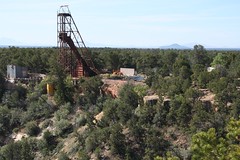
No More Uranium Here
Originally uploaded by cogdogblog


The abandoned uranium mine situated on the edge of the Grand Canyon (dubbed Orphan Mine) signals the end of one era and the possible beginning of another. The uranium mining frenzy and speculation that spread radioactive tailings, planted the seeds of cancer, and despoiled rivers and reserverations throughout the West seem likely to begin again, as discussed in Big Bad Boom by Chip Ward.

Ward paints a grim picture of the process:

So we in states like Utah, Nevada, Arizona, New Mexico, and Montana are poised for a mining boom reminiscent of the one in the 1950s when the nuclear age began. Then, the West’s uranium mines provided the raw material for our metastasizing Cold War nuclear arsenal and the nation’s first generation of nuclear reactors. (You remember Three Mile Island, don’t you?) Back then, radioactive ore was often dug out by impoverished Navajo miners desperate for jobs. Many of them later sickened and died from exposure to radioactivity.

After uranium has been turned into “yellowcake,” fit for further processing into reactor fuel, and then used to power a nuclear reactor, it is supposed to return to our Western landscapes in the form of “spent” nuclear fuel — something that is lethally dangerous for tens of thousands of years. Our arid landscapes, we are told, are ideal for waste that must be kept isolated and dry for at least a thousand years.

In other words, we get it at both ends of the nuclear energy cycle — and the drier we get, the more appealing we look. First, they dig a hole and take it out; then, they dig another and return it to the ground in far more dangerous shape. Lurking between the mines and the waste dumps are processing mills — and, of course, we have them, too. Even as debris from toxic slag piles in the old mines and mills of the West is still blowing in the wind or leaching into our watersheds, new slag heaps are taking shape in the fevered dreams of the next generation of speculators.


With abundant renewable energy sources ready to meet our national requirements, there is no good reason to resurrect radioactive ghosts from the failures of the past.

Sunday, June 15, 2008

The Greening of the Hawks

greening_hawks

With the urgency of climate destabilization growing daily, the purity of one's ideological calling card becomes less important than the need to phase out fossil fuels and phase in renewable energy as quickly as possible. As Laura Rozen reports in a Mother Jones article, James Woolsey, Hybrid Hawk, neoconservatives and Iraq war boosters are increasingly seeing the wisdom of clean energy. Though they may cloak the shift as a matter of national security, rather than a means of combatting global warming, many of them are becoming unlikely allies in the quest to beat oil addiction.

Rozen's dialogue with James Woolsey unearthed some interesting revelations:

Woolsey recalls the moment he started thinking seriously about energy as both an environmental and strategic issue. "I was sitting in my car in a gas line in Washington in '73, after the Saudis had declared an oil embargo on us and Israel was attacked," he says. "And I got mad." Energy issues have captivated him ever since. In the early '80s, he joined the Jefferson Group, an alternative-fuel salon founded on the Jeffersonian ideal "that the future of America is determined by the independent yeoman farmer."

An independent streak has run throughout Woolsey's 40-plus years in Washington. He has served in four administrations, both Republican and Democratic. In the twilight of the Cold War, he found himself increasingly identifying with Republicans on national security. He spent three years as a member of then-defense secretary Donald Rumsfeld's Defense Policy Board. When I met with him, he was expecting another career change, leaving the federal contractor Booz Allen Hamilton to join a California firm that invests in alternative-energy technology. He'd also just appeared in an anti-oil print ad for the American Clean Skies Foundation, a PR group started by a natural gas company.


With earth's future in the balance, we need all the clean energy promoters we can get.

Monday, June 02, 2008

Finding the Ultimate Battery

batteries

Storing energy effectively lies at the heart of our contemporary quest for escaping fossil fuel addiction. Two of the most promising alternative energy sources, wind and solar, are inconsistent throughout the day or week or month. Without a means of capturing the energy so generated for those times when the sun doesn't shine or the wind doesn't blow, the potential is diminished. And the vast promise of electric cars hinges on the ability to extend their range sufficiently so you don't run out of power on the way home from work.

Lee Hart, a self-employed electrical engineer profiled in a recent Mother Jones article, A Charge to Keep, tracks the progress of battery technology from his basement lab. What he has learned in the course of rigorous testing is enlightening.

Britt Robson, the writer of this piece, nurses out the crux of the problem:

Hart has heard the dreamers wax on about a time when batteries will run for days on end, revolutionizing plug-in cars, windmills, and solar panels—just about any source of alternative energy would benefit from good batteries, which allow electricity to be stored and transported. He has sympathy for those visions. A motto of his hero, Thomas Edison, is inscribed on a favorite sweatshirt: "To invent you need a good imagination and a pile of junk." Like most electro-geeks who'd rather tinker than strut, he also adheres to Edison's practical DIY ethos, which explains the battery room and the small fleet of electric cars he has either retrofitted or built from scratch. His tests invariably reinforce what he and most everyone else familiar with the battery market have long known. When it comes to practical applications for sustainable energy, batteries are more of an Achilles' heel than a panacea, because we are running 21st-century technology with what is essentially 18th- or 19th-century chemistry.


Hart's work is leaning toward extending available battery power by creating light, structurally solid automobile frames, favoring efficiency over raw power.

But the main innovation in Hart's car has nothing to do with how it's powered—it'll be compatible with any kind of battery—but rather with its strong and lightweight frame, influenced by the ultraefficient "hypercar" philosophy of environmentalist Amory Lovins. "If I make the car lighter, I still get the fuel economy I'm looking for," notes Hart. In other words, for now, the best way to get more out of batteries is to simply demand less of them.


Improved efficiency could make a tremendous contribution to reducing our energy-consumptive habits, as has been thoroughly documented by the Rocky Mountain Institute, providing savings in home and business heating and cooling, industrial operations, and transportation. And even the variability of solar and wind power is not as straightforward as you might think, as this RMI article, Rethinking the Reliability of Solar and Wind Power, points out.

The solutions are out there, if only we'd take advantage of them.

Sunday, May 18, 2008

Generating Jobs, Producing Energy


The tired, old energy paradigms of the last hunded years and the fixation on fossil fuels do nothing for solving climate destabilization problems. In this interview produced by The Real News Network, José Etcheverry, an energy policy analyst for the David Suzuki Foundation, explains how renewable resources, including solar and wind power, encourage a decentralized energy model where individual communities benefit not only from cost-effective power, but jobs and a steady flow of revenues as well.

Monday, May 12, 2008

Rolling Back Carbon Dioxide

Serene iceberg

The latest message from Bill McKibben is clear: when it comes to climate destabilization, there are no do-overs. McKibben, a latter-day Paul Revere who has been writing about the growing risks of climate change for almost 20 years, is direct and to the point in his latest article, Earth at 350. The number 350 represents the number of parts per million of carbon dioxide in the atmosphere that may help us avoid the tipping points, predicted by NASA climatologist Jim Hansen, that could accumulatively plunge the planet into a death spiral of climatic change. Right now, we're at 385 ppm. Are we smart enough and dedicated enough as a species to reverse current trends and bring CO2 levels down? McKibben thinks so, but it's going to take massive reorganization of our cultural habits and national proclivities to cap the still rising carbon levels.

We're the ones who kicked off the warming; now, the planet is starting to take over the job. Melt all that Arctic ice, for instance, and suddenly the nice white shield that reflected 80 percent of incoming solar radiation back into space has turned to blue water that absorbs 80 percent of the sun's heat. Such feedbacks are beyond history, though not in the sense that Francis Fukuyama had in mind.

And we have, at best, a few years to short-circuit them--to reverse course. Here's the Indian scientist and economist Rajendra Pachauri, who accepted the Nobel Prize on behalf of the Intergovernmental Panel on Climate Change last year (and, by the way, got his job when the Bush Administration, at the behest of Exxon Mobil, forced out his predecessor): "If there's no action before 2012, that's too late. What we do in the next two to three years will determine our future. This is the defining moment."

In the next two or three years, the nations of the world are supposed to be negotiating a successor treaty to the Kyoto Accord. When December 2009 rolls around, heads of state are supposed to converge on Copenhagen to sign a treaty--a treaty that would go into effect at the last plausible moment to heed the most basic and crucial of limits on atmospheric CO2.

If we did everything right, says Hansen, we could see carbon emissions start to fall fairly rapidly and the oceans begin to pull some of that CO2 out of the atmosphere. Before the century was out we might even be on track back to 350. We might stop just short of some of those tipping points, like the Road Runner screeching to a halt at the very edge of the cliff.


McKibben hopes the last-minute Hail Mary pass will be caught.

A few of us have just launched a new campaign, 350.org. Its only goal is to spread this number around the world in the next eighteen months, via art and music and ruckuses of all kinds, in the hope that it will push those post-Kyoto negotiations in the direction of reality.


Depending on who you talk to, optimist or pessimist, we either face salvation or extinction. We can marshall our resources and ingenuity and turn things around, or, alternatively, we can continue whining that humans are too stupid to change and the planet is doomed, and do nothing as temperatures continue to rise. If we're doomed (certainly a distinct possibility), wouldn't you prefer to be on the side of those actively fighting to make the necessary changes to stabilize the climate and just maybe cast the die in favor of survival? Something to consider...

Wednesday, April 30, 2008

A Practical Electric Car

thinkglobal_2

As gasoline prices have soared and global warming concerns have reached a crescendo, many automobile buyers have cast at least a passing eye at electric cars. Prototypes keep turning up a car shows, some rudimentary models are available through sources such as ZAP!, but most choices have looked like impractical compromises (too expensive, not enough range, not enough speed, not enough room).

A Norwegian firm, Th!nk, is trying to change the equation and plans to introduce their battery-powered Think City in the United States by the end of 2009. With a projected price of $17,000, a range of 110 miles, and a top speed of 65 mph, this may be the vehicle that breaks down the barriers that have kept electric cars from gaining a foothold (or is that a tirehold) in the market.

Writing for WIRED, Marty Jerome commented on the plans and the history of the company:

Spokespeople for Think plan to produce 30,000 to 50,000 within two years. Currently the company produces 10,000 vehicles per year in Europe.

Think North America, as its U.S. arm is called, will build cars in Southern California. The vehicle was originally developed by Ford, though it sold it to Norwegian investors in 2003. And while there are a half-dozen U.S. startups working on electric cars, Think has received backing most recently from General Electric. It also has backing from venture capital firms that include RockPort Capital Partners and Silicon Valley heavyweight, Kleiner, Perkins, Caufield & Byers.

Of course, money rarely tells you whether an electric car company can actually deliver on its promises. Failures and fraud have been rife in the industry.


Having watched many promising prospects rise and fall in the electric car sector, Th!nk may be on to something real with this latest offering.

Thursday, April 10, 2008

Solar City in the Desert

Call it a proof of concept for solar energy or an example for the rest of the world. The self-sufficient Abu Dhabi solar city provides an intriguing model for other communities and a hint at the possibilities of solar energy in future applications.

Wednesday, April 02, 2008

Worse than the IPCC Projected

Collapsing ice shelves in Antarctica, including the recent split of a slab seven times the size of Manhattan, are part of a pattern, which appears to indicate climate destabilization is progressing faster than IPCC predictions. As reported by the REAL news network:

Saturday, March 29, 2008

Wind Turbine Leader

windmill_lake_shore

When the OPEC crisis struck in the 70's, Denmark didn't waste any time seeking out new sources of energy. They immediately embarked on a nationwide initiative to develop wind power and they now own 40 percent of the global market. The country is also a mecca for bicyclists and during a typical commute in busy Copenhagen you will encounter more bicycles than cars.

The Toronto Star reports on the Danish proclivity toward efficiency, compact living arrangements, and smart engineering. When the national leadership falters, the municipal leaders step in.

But even as climate campaigners chide their national government's recalcitrance, most offer high praise for Copenhagen's municipal leadership, which has set itself an ambitious goal for 2015 to become what it calls the world's "Eco-Metropole" – the cleanest, greenest, lowest-emitting city on the planet.

"The things we've already achieved show us that Copenhagen doesn't need national legislation to go even further. We can do most of this on our own," said Klaus Bondam, the city's mayor of technology and the environment. "Cleaning up our harbour so that you can swim and catch cod fish, enhancing our cycling network to where it is today, becoming one of the first in the world to convert the wasted heat of electrical generation into heat for our homes – Copenhagen has done all this. And now we lead Europe. By 2015, we'll lead the world."

Among the city's goals is a plan to raise to 50 per cent the number of downtown commuters arriving by bicycle. The number seems otherworldly, until you consider that bikes comprise 36 per cent of downtown traffic, compared to only 27 per cent private automobiles.

To fully comprehend how such numbers are possible, the Toronto Star sought a history lesson from Dansk Cyklist Forbund – the Federation of Danish Cyclists – an organization launched in 1905 when the pressing issue of the day was punctures resulting from horseshoe nails littered along Copenhagen's network of horse paths.

"Here in Copenhagen, riding a bike is like wearing shoes," said DCF's Allan Carstensen. "It's normal. It's easy. It's convenient. People ride in their work clothes. And even the people in cars, the chances are they have a bike at home that they use regularly to run errands in the neighbourhood."


As the article points out, the dependence on coal is a sore spot in this picture, but positive steps are underway to lessen coal usage.

Friday, March 28, 2008

Uranium Mining: The Dirty Side of "Clean" Nuclear Power

Those who tout the benefits of "clean" nuclear energy don't usually talk much at all about the dirty sides to this industry: uranium mining. As many of the most abundant sources of ore are on Native American lands, the pressure is on once again to open these lands to mining.

As reported by the Washington Post, Navajos in particular have borne the consequences of mining operations.

Like many Navajos who worked in the mines, Larry J. King didn't know then that there was anything dangerous about it. "We had no respirators; you'd have sweat running down your face with the uranium dust getting in your ears, nose and mouth," said King, who surveyed mine tunnels from 1975 to 1982. "You couldn't help but swallow it."

During mining's peak, from the early 1950s to the early 1980s, about 400 million pounds of uranium were extracted from the region. At the end of the boom, around 1984, the price of uranium languished below $10 a pound. Mines shut down, and the United States began importing nearly all of its uranium, with the bulk coming now from Canada, Russia and Australia. But by last summer, the price had rebounded to a record high of $136 a pound.

Though the mines created numerous jobs and substantial royalties for the Navajo and Laguna tribes, the decades of extraction took a heavy toll: lung cancer, kidney disease, birth defects and other ailments at notably high levels among miners and families who lived among piles of uranium tailings -- the ground-up waste from milling -- and even used the material to build their homes.

All but one of the major companies now seeking to mine in New Mexico are newcomers to the state and have promised to do a better job than their predecessors. In addition, pending state legislation would require them to deposit a small percentage of their profits in a "legacy fund" to clean up existing uranium contamination.

But King said, "I don't believe them one bit."

He blames his recent health problems on uranium. He remembers July 16, 1979, when more than 90 million gallons of uranium-contaminated water burst through the dam of a tailings holding pond and into the Puerco River running by his land. And he remembers seeing his cattle drop dead from, he thinks, drinking polluted mine runoff.


There is other dirt deeply embedded under this industry's fingernails as well, of course. Periodic tritium discharges from the stacks. Fish kills from overheated cooling water effluent. The carbon costs of the coal-fired plants that power the uranium processing facilities.

But, that's another story for another day.

Thursday, March 27, 2008

Nuclear Power, By the Numbers

nuke_plant_san_onofre

Nuclear power, the most expensive technique for boiling water ever invented, is perhaps best described by the numbers.

Amount that a dollar spent on energy efficiency and renewable energy goes toward reducing CO2 emissions compared to a dollar spent on nuclear power: 7 to 10 times

Number of dirty, coal-fired plants required in Kentucky to operate two uranium enrichment plants: 4

Percentage increase in ovarian and testicular cancer among children in Navajo lands adjacent to uranium mining operations performed in the 1950's: 1,500

Year that India's first commercial nuclear power reactor went on line: 1969

Year that India performed its first test of a nuclear bomb: 1974

Number of days the $10-billion French faster breeder reactor, Superphenix, operated during an 11-year span before being permanently shut down following a massive leak of sodium coolant: 287

Number of French reactors that shut down during the heat wave of 2003 because of a rise in the temperature of cooling water from rivers: 17

Number of tons of plutonium oxide powder transported annually to French MOX fuel reprocessing facilities in Belgium and southern France: 10

Number of metric tons of plutonium stored worldwide as of 2003: 240

Number of pounds of plutonium required to make a nuclear weapon: <20

Percentage of CFC-114 gas released into the air as a result of uranium enrichment in the U.S.: 90

Number of times that CFC is more potent as a heat trapper and global warmer than CO2: 10,000 - 20,000

Percentage of citizens in France polled in 2006 who favor a phase-out of nuclear energy: 61

Number of peak early fatalities predicted by the Nuclear Regulatory Commission in their Calculation of Reactor Accident Consequences study if the Salem 2 nuclear plant in New Jersey suffered a meltdown: 100,000

Property damage estimated in the CRAC 2 study from a Salem 2 meltdown (in 1980 dollars): $155,000,000,000

Number of energy companies that Don Hintz, President of Entergy, says can afford the $1.5 - 2 billion cost of building a nuclear reactor right now: 0

Draw your own conclusions...

Thursday, March 13, 2008

Food and Climate Change

tractor

In discussions about what to do to reverse climate change, most people--whether environmentalists, politicians, or plain ordinary folks--overlook an obvious, yet largely ignored, source of greenhouse gas emissions: the global industrial food system. This elephant in the room seems to escape attention in the media, in legislative chambers, and in coffeeshop discussions, despite the fact that our crop- and livestock-raising practices represent about 33 percent of the greenhouse gas totals generated by human activities.

Anna Lappé, writing for Seattlepi.com, cites data analysis by the Pew Center on Global Climate that blames the livestock sector by itself for one-fifth of the total world emissions. This represents more emissions than is produced by all the planes, trains, and automobiles on the planet.

We are deeply wedded to a system that is inexorably leading to climate changes that could eventually make the planet uninhabitable.

Industrial farming is particularly problematic because it is a key emitter of methane and nitrous oxide, which have, respectively, 23 and 296 times the global warming effect of carbon dioxide. In the United States, widespread use of nitrogen fertilizer, roughly half of which is wasted in leaching and runoff, contributes to approximately three-quarters of the country's nitrous oxide emissions. Globally, agriculture is responsible for nearly two-thirds of methane emissions.

With climate scientists warning we need an 80 percent reduction in greenhouse gas emissions by 2050 to avert planetary catastrophe, it's clear we need bold action -- and that bold action must include re-thinking food.


The article, despite the grim scenario depicted, has a hopeful tone, highlighting a rapidly emerging counterweight to the excesses of industrial farming: climate-friendly farming practiced on family-scale farms. Miniscule in scope at the moment compared to the overall agricultural behemoths that dominate the landscape, organic gardening as practiced by small farms such as Seattle Tilth, may be our best bet for the future.

As Anna concludes:

An organization such as Seattle Tilth may seem like a tiny drop in the climate-change bucket, but its impact should not be measured in isolation. Dozens of sister efforts are flourishing -- from Austin, Texas, to Ypsilanti, Mich. -- encouraging people to reconnect with their food and giving people the opportunity to get their hands in the dirt.

Yes, the specter of climate chaos is daunting, but day-by-day and garden-by-garden organizations such as Seattle Tilth are showing a homegrown way to address the crisis.


Well said...

Saturday, March 08, 2008

Stackable Cars

citystack

From Julia Whitty and The BlueMarble Blog comes a story of a prototype vehicle: an electric car that is designed for shared use. Drive it, return it, and stack it for the next commuter. General Motors is behind the concept for the CityCar, which includes a robotic drive mechanism and omnidirectional wheel configuration.

Whitty says:

Imagine if parking, drive time, congestion, navigation, and your fellow driver was no longer an issue. Imagine what that might do to emotional health, personal time & energy budgets, neighborly love, and the big CO2 footprint in the sky. Imagine if we didn't need to compete for space but could happily piggyback on each other. Okay, call me an idealist but there are days when the future looks good enough for hope... You'll have to navigate on your own through the Smart Cities pages to find the City Car. But it's a really fun ride.


Can Americans escape the notion of a car (or two) in every garage and embrace shared vehicles, like the community bicycle programs that are popular in Amstersdam and have been tried in other cities, as well? Maybe when the price of gasoline reaches $7 per gallon.

Tuesday, March 04, 2008

Zero-Emission Sports Car

morgan_fuel_cell

I'm a sucker for a sleek sports car. The rational part of my brain tells me that if we, as a society, don't overcome our obsession with automobiles, our rapid slide toward an unbearable tropical greenhouse climate will accelerate. But, from the time I was thirteen years old and discovered a stash of Car and Driver and Road and Track magazines in the garage of the home my family was renting, I was hooked. The photos of Sunbeam Alpines, Austin Healy 3000's, Morgan roadsters, Triumph TR-3's, and other four-wheeled exotica created a deep-seated love of sports cars that has yet to ebb.

So, although I will probably never own a Tesla or Morgan Lifecar (shown in the photo and styled after the Morgan-8 roadster), I think that the technologies that these automotive marvels are introducing are our best bet for preserving some measure of high-speed, independent mobility in the future. I also think that we should shift our transportation more toward mass transit, bicycling, and walking, with maybe a hybrid electric motorcycle thrown in for good measure, but we have the roads, we have the parking lots. Let's use them wisely as we transition to a people-oriented society rather than one where carbon-emitting motor vehicles dominate.

The Morgan Motor Company has been around since 1906, but their new fuel-cell powered sports car is an undeniable show stopper. It travels 250 miles per tank of hydrogen, accelerates from 0-60 in roughly 7 seconds, tops 90 miles per hour, and is being unveiled at the upcoming Geneva Motor Show on the 6th of March. Morgan will gauge production plans based on the response. As discussed in a BBC News article, Green sports car set for launch, the car was designed to minimize weight, which precludes including some features that typical car owners are accustomed to:

It also doesn't have any of the "luxuries" such as a stereo, central locking or even airbags, found on many modern cars.

"The objective is to get the weight down to 700kg."

There are also other notable omissions such as a gearbox and - as the fuels cells produce little noise - the roar of an engine.

"We may have to supply headphones with the sounds of a five litre V8 linked to the throttle pedal," said Mr Parkin.


Critics will point out that hydrogen fuel cells are a storage system, not a form of energy, but this critique ignores much work that is being done to provide a decentralized means of accumulating energy through wind turbines, solar panels, and other energy sources. What's wrong with driving a car that runs from hydrogen produced from a wind turbine on your garage roof, as described in More Wind Power!. A hybrid approach may be our best means of coping with diminishing fossil fuel reserves.

Using more advanced technologies, electricity from wind turbines can be stored by compressing or heating substances in tanks. One of the most promising ways to store surplus wind power is by producing hydrogen. Hydrogen can be stored under pressure in tanks, to provide fuel for industrial or domestic use or in cars, all without creating pollution. As discussed in more detail in an earlier article, electric vehicles can also run on Lithium-ion batteries that can be recharged from the solar panels on top of the roofs under which they are parked.

Anyway, more electric cars means that we need to generate more electricity, and wind power is one of the easiest and cleanest ways to do so. We can choose the times when best to recharge the batteries or produce the necessary hydrogen, so we can do so when it's windy and when there's little further demand, so it will take little or no electricity away from other usage. Look at it this way and claims that wind power was unreliable and that hydrogen was inefficient do not hold.


Critics will always be found for any proposed transportation solution that doesn't fit their personal intellectual blinders. I personally think that smart technology applied in ways that minimize environmental impact and lower carbon emissions can set us on the road to reversing global warming while still enjoying the occasional top-down drive through the countryside.

Friday, February 29, 2008

Getting Energized for Change

45McKibben_Tree

From a rural outpost in Ripton, Vermont, Bill McKibben has been waging a tireless campaign against global warming. He started back when only a handful of people were even discussing the issue; the publication of his book, The End of Nature, in 1989 clarified many of the concepts that only today have become almost universally embraced.

McKibben is now working to energize people around the globe to make the necessary changes to avert what he sees as an accelerating disaster, the magnitude of which dwarfs all our other social problems. His Step It Up activities in 2007 rallied a large part of the nation to the cause. But, McKibben's message in 2008, articulated in a recent Yes! magazine article, First, Step Up, is that global warming is happening faster than expected and an enormous social movement will be needed to stop it.

McKibben gave some examples to suggest the scale of the problem:

What exactly do I mean by large? Last fall the scientists who study sea ice in the Arctic reported that it was melting even faster than they’d predicted. We blew by the old record for ice loss in mid-August, and by the time the long polar night finally descended, the fabled Northwest Passage was open for navigation for the first time in recorded history. That is to say, from outer space the Earth already looks very different: less white, more blue.

What do I mean by large? On the glaciers of Greenland, 10 percent more ice melted last summer than any year for which we have records. This is bad news because, unlike sea ice, Greenland’s vast frozen mass sits above rock, and when it melts, the oceans rise—potentially a lot. James Hansen, America’s foremost climatologist, testified in court last year that we might see sea level increase as much as six meters—nearly 20 feet—in the course of this century. With that, the view from space looks very different indeed (not to mention the view from the office buildings of any coastal city on earth).

What do I mean by large? Already higher heat is causing drought in arid areas the world over. In Australia things have gotten so bad that agricultural output is falling fast in the continent’s biggest river basin, and the nation’s prime minister is urging his people to pray for rain. Aussie native Rupert Murdoch is so rattled he’s announced plans to make his NewsCorp empire (think Fox News) carbon neutral. Australian voters ousted their old government last fall, largely because of concerns over climate.


The answer, McKibben thinks, is in building the largest social movement ever known.

Most of all, we need a movement. We need a political swell larger than the civil rights movement—as passionate and as willing to sacrifice. Without it, we’re not going to best the fossil fuel companies and the auto-makers and the rest of the vested interests that are keeping us from change.

Some of us have spent the last couple of years trying to build that movement, and we’ve had some success. With no money and no organization, seven of us launched StepItUp in January 2007. Before the year was out, we’d helped organize 2,000 demonstrations in all 50 states—and helped take our once-radical demand for an 80 percent reduction in U.S. carbon emissions by mid-century into the halls of power.


The conclusion of the article manages to be optimistic. Despite the scope of the challenge, there are many actions we can take collectively and individually to spur the necessary change. But, it's clear we need to start now and the changes need to be deep. Fasten your seat belts; it's going to be a bumpy night.

Tuesday, February 26, 2008

Harvesting Energy from Compost

leaves_for_composting.jpg

The proliferation of small-scale power plants is skyrocketing across New England as many communities are tapping into abundant, natural sources of energy--from Cow Power in Vermont to a plan in Boston to use Fall foliage for something other than to attract tourists.

A staff writer for Boston.com, Andrew Ryan, revealed the innovative scheme for tapping yard clippings, leaves, and food scraps to produce heat and electrical power. "Urban decay, redefined" describes a plan to generate electricity for up to 1,500 homes and heat for a rooftop greenhouse from the power of compost.

The project, which is still in the early conceptual stage, would take the city's 6,000-ton composting program indoors. For more than a decade, leaves and yard clippings have been collected each spring and fall and trucked to a muddy clearing off American Legion Highway in Roslindale. The undulating mound is almost two stories tall, loaded with tan, brown, and black leaves in various states of decay. On a recent afternoon, white steam gushed from the pile, evidence that microorganisms were hard at work, generating heat that pushes the internal temperature near 130 degrees, said Nora Goldstein, executive editor of BioCycle magazine.

In an enclosed facility, officials would recycle heat and biogas released when leaves, grass clippings, and other organic material decay. Biogas includes methane, which would fuel a turbine, generating up to 1.5 megawatts of power, and carbon dioxide, which would nurture plants in the greenhouse.

"There have been pieces of this that have been done other places, so there isn't as much of a worry that it would fail," said Tom L. Richard, director of the Institutes of Energy and the Environment at Penn State University. "But it is new enough and innovative enough that it would hopefully be an example that other places in the country could follow."


The move toward collecting energy from materials we normally consider "waste"--whether cow pies or maple leaves--is an indicator that we can solve many of our energy needs simply through resourcefulness and ingenuity. Why build more coal and nuclear power plants when abundant renewable energy sources surround us?

Saturday, February 23, 2008

Profitability in Clean Energy Technology

earth_clouds

Fighting climate change can be profitable. An article in the Christian Science Monitor, Business begins to see profit in going green, refutes the argument that combatting climate change will cripple the economy. Instead, clean energy technologies and the carbon-trading market appear likely to drive profitability and re-invigorate the economy.

Some of the indicators from the article:

A new study by international consulting firm McKinsey finds that half the necessary cuts in greenhouse-gas emissions can be achieved at a net profit. The study shows that investment in energy efficiency of about $170 billion annually worldwide would yield a profit of about 17 percent, or $29 billion. The Financial Times reports:

"Diana Farrell, director of the McKinsey Global Institute, said: 'It shows just how much deadweight loss there is in the economy in energy use.' She said the most inefficient sector was heavy industry in China, with the second residential housing in the US, where homes are large, poorly insulated ..."

At the United Nations Investor Summit on Climate Risk in New York last week, nearly 50 major US and international investors pledged to invest $10 billion in clean technology over the next two years. That's considerably more than two years ago when 26 funds made a $1 billion pledge.


Given the slow response by governments worldwide to taking any kind of action on climate change, it's a promising sign that businesses seem to be taking a leadership role in driving clean energy initiatives.

Friday, February 22, 2008

Take a Ride in the Tesla

There have been some management upheavals at Tesla Motors since this video first aired in November of 2007, but you can still get a sense of what a revolutionary car looks like and how it drives by watching the video. The company plan is to progressively drive the price down from the current $92,000 tag to where subsequent models will penetrate that conventional strata where Accord, Camry, and Taurus drivers now reside. Interesting plan... Will it succeed? Look at the vehicle and you tell me.

Thursday, February 21, 2008

Geothermal, the Unsung Power Source

CA_geothermal

Electricity from geothermal power rarely gets ink in the press the way more glamorous renewables do—including solar, wind, and biomass—but in some places, such as California, it already is making a substantial contribution to power requirements. A recent article in MercuryNews.com talked about the efforts in The Geysers to harvest energy from underground steam.

The potential for this energy source is signficant:

In all, The Geysers generates 4.7 percent of California's electricity - far more than solar, wind and biomass projects - and its capacity again is growing.

The Geysers is part of a nationwide boom. A recent report from the Geothermal Energy Association in Washington, D.C., showed a 40 percent increase in the number of geothermal projects around the country in just the last year. It said 86 new projects are under way in 12 states with a potential capacity of 3,368 megawatts. In California, one megawatt is enough to power 1,000 homes for a year.

In fact, it's a global phenomenon. "Geothermal is a hot topic around the world," said ThermaSource's Capuano, a big man with a lot of Mississippi still in his voice.


The Union of Concerned Scientists offers a good overview explanation of the geothermal potential in the U.S. here. The summary paragraph reads:

The U.S. Geological Survey estimates the geothermal resource base in the United States to be between 95,000 and 150,000 MW, of which about 22,000 MW have been identified as suitable for electric power generation. Unfortunately, only a fraction of this resource is currently utilized, with an installed capacity of 2,800 MW (worldwide capacity is approximately 8,000 MW). But thanks to declining costs and state and federal support, geothermal development is likely to increase. Over the next decade, new geothermal projects are expected to come online to increase U.S. capacity to between 8,000 and 15,000 MW. As hot dry rock technologies improve and become competitive, even more of the largely untapped geothermal resource could be developed. In addition to electric power generation, which is focused primarily in the western United States, there is a bright future for the direct use of geothermal resources as a heating source for homes and businesses everywhere.

Wednesday, February 20, 2008

Rapid Climate Destabilization

A self-described geeky science teacher updates his previous YouTube argument about climate change action with a well-reasoned risk management slant. The original argument got over a million views. The updated version deals with the fallout and critique of the original. It's a light touch granted to a terrifying issue and the latest video manages to be both entertaining and informative.


For more material from this prolific presenter, visit his home.

Monday, February 18, 2008

Scientific American's Grand Plan

sun power

If you're paying attention, you know that the U.S. desperately needs to transform its energy strategy to reduce fossil-fuel use and minimize carbon emissions. The proposals trickling out of Congress are generally tepid half measures that fail to address the critical nature of the problem.

Scientific American put a group of their analysts to work and crafted a grand plan to eliminate dependence on imported oil. And, best of all, the cost is much less than what the country is spending today on ill-advised military adventures around the world.

The linchpin of the plan is solar electricity. From the article:

Solar energy’s potential is off the chart. The energy in sunlight striking the earth for 40 minutes is equivalent to global energy consumption for a year. The U.S. is lucky to be endowed with a vast resource; at least 250,000 square miles of land in the Southwest alone are suitable for constructing solar power plants, and that land receives more than 4,500 quadrillion British thermal units (Btu) of solar radiation a year. Converting only 2.5 percent of that radiation into electricity would match the nation’s total energy consumption in 2006.


The plan also describes how development of wind, biomass, and geothermal energy systems could eventually supply 100 percent of the nation's requirements and 90 percent by the year 2100. Energy independence is within reach, but we also need to dramatically scale down the lost dollars being funneled into military interventions.

Sunday, February 17, 2008

Traversing the Biofuels Thicket

stockxpertcom_id272604_size1

An article in Science last week caught everyone's attention. The title says it all: Use of U.S. Croplands for Biofuels Increases Greenhouse Gases Through Emissions from Land Use Change. In a world where many governments are mandating a shift to ethanol, this sounds like trouble. It's trouble on top of trouble, since we're hearing more about how growing corn, soybeans, and sugar cane to convert to ethanol is raising food prices.

The Science article spawned mainstream media interpretations with eye-catching headlines. The Los Angeles Times hollered: Biofuel crops increase carbon emissions. The New York Times warned: Biofuels Deemed a Greenhouse Threat. Bloggers and environmental sites picked up the excitement and soon lively discussion threads were debating whether switchgrass, algae, and cropland waste posed the same challenge, and whether co-generation plants could produce the ethanol cleanly when compared to the plants springing up in Iowa that are burning coal to generate ethanol from corn.

Many of the discussions, both in the mainstream media (once clear of the headlines) and blog posts, were knowledgeable and intriguing, posing solutions that only occasionally get a public airing. I was fascinating by descriptions of techniques for modifying your car to run on denatured alcohol and inventive ways you could then distill your own fuel in the backyard. And, if you're worried about destroying croplands, why not make biodiesel from algae using smokestack emissions.

A couple of hours sorting through the voluminous articles, posts, arguments, and counter-arguments left me a bit dazed. What was fairly clear is that we have many possible solutions to our energy needs. Some of them have been viable for 100 years or more (such as alcohol-powered vehicles). But, in spite of a wealth of workable solutions, governments around the world and large corporations hoping to hedge their bets on energy futures are pushing large-scale, often destructive projects. Whether clearing rainforests to grow more sugar cane for ethanol or diverting corn from being a food source to being a fuel, the impacts of these processes are abundantly evident.

And a solution that is immediately at hand, and doesn't require toppling a single tree, is improving energy efficiency. A longtime champion of fuel savings as an unheralded solution to many of our energy needs, Amory Lovins, co-founder of the Rocky Mountain Institute, sees profitability and smaller carbon footprints in using less fuel. A recent Newsweek article by Lovins, How to Fuel the Country While Saving the World, highlights a realistic path to conversing energy rather than squandering it.

Individual choices as well can make a huge difference as people adopt energy-efficient, low-impact lifestyles. We need to face that fact that change may not come from our prevaricating, slow-to-react national leaders, but local activism and lifestyle changes can induce energy savings from the community grassroots level. And on the individual level, especially when it comes to transportation, much can be done. Take a vacation by train this year instead of flying. Car pool to work. Get a bicycle or walk when running errands around town. Cut your weekly shopping trips to one instead of three. Think about getting an electric car--they're available if you do some hunting and more will be available in the near future. Talk your boss into letting you telecommute one or two days a week. Even simple steps like this can cut down your energy use for personal transportation 20 to 40 percent.

Personally, I'm going to look into converting my old SAAB 900 to run on alcohol and see what kind of vegetable matter already growing around my modest one acre lot might be fodder for the distiller. And, an alcohol-powered motorcycle might be fun...

Thursday, February 14, 2008

Enhanced Solar Energy Capture

stirling_solardish1

Stirling Energy Systems, in collaboration with Sandia National Laboratories, has improved solar-to-grid system conversion efficiency to 31.25 percent, using enhanced optics and a more refined focusing system. Stirling has power purchase agreements in place with two Southern California utility companies and is ramping up to commercialize their SunCatcher system.

How does it work?

The solar dish generates electricity by focusing the Sun's rays onto a receiver, which transmits the heat energy to a Stirling engine.

The engine is a sealed system filled with hydrogen. As the gas heats and cools, its pressure rises and falls. The change in pressure drives the pistons inside the engine, producing mechanical power, which in turn drives a generator and makes electricity.

SES owns the dishes and the associated hardware at the Test Facility. Sandia provides technical and analytical support to SES in a relationship that dates back more than 10 years.


More details available through this release from the Environment News Service.

Tuesday, February 12, 2008

Here Come the Insects

hopper

The threats from global warming, at least in the popular imagination, usually involve flooded coastal cities, parched croplands, and extreme weather events. Some researchers at Pennsylvania State University have identified another potent challenge if temperatures rise another few degrees. As described in an article in The Independent, Insect explosion 'a threat to food crops', leaf-eating bugs may ravage plants across the globe, following a pattern documented in fossils from the palaeocene-eocene thermal maximum (PETM) period. Science editor Steve Connor wrote:

The percentage of leaves that suffered extensive insect damage rose dramatically during the PETM as foraging became more intensive. The researchers warned that the same effect might be seen during the present period of global warming caused by man-made emissions of CO2, which could double the pre-industrial concentration of the gas by the end of the century.


The pattern noted by the lead author of the study, Ellen Currano, included hungrier insects and less nutritious plants.

"We think that the warming allowed insect species from the tropics ... to migrate north," Ms Currano said.

In addition to migration from tropical regions, the scientists believe that insects had to eat more because the rising concentrations of CO2 in the atmosphere made leaves less nutritious because they contained relatively smaller concentrations of nitrogen. "With more CO2 available to plants, photosynthesis is easier and plants can make the same amount of food for themselves without having to put so much protein in their leaves," Ms Currano said.

Consequently, when CO2 increases, leaves have less protein and insects need to eat more to acquire the nutrients they need. Plants can grow faster when CO2 levels rise, but they suffer from a disproportionate increase in damage, she said.


No one is quite sure what triggered global warming in the PETM era. But, we do know man-made emissions are causing our present-day temperature increases.

Sunday, February 10, 2008

U.S. Automakers Toy with Plug-In Concepts

Chrysler and GM are jockeying to introduce viable plug-in hybrid vehicles, convinced that the market is finally ready for a practical electric car. The versions appearing at auto shows may not be the same as the vehicles that actually reach production. A Gartner analyst quoted thinks that instead of making a true commitment to the technology, the automotive industry still seems to be dancing around the fringes.

The MercuryNew.com article, Chrysler rolls out three plug-in concept models, describes these latest concepts:

Chrysler's entries in the concept race are the Chrysler ecoVoyager, Dodge Zeo and Jeep Renegade. Officials say consumer demand isn't generated solely by technology. It also needs to come with distinctive designs - in other words, no one-size-fits all approach.

Frank Klegon, Chrysler's product development chief, said the Zeo concept, which is completely electric, is designed to maintain Dodge's tradition of performance. The ecoVoyager, coupled with a fuel cell, is meant to convey Chrysler's reputation as an "iconic American brand." And the Renegade, combined with a low-emission diesel engine, is envisioned as a vehicle that could "go anywhere" and "go green."
Still, he said, they are purely concepts with no production guarantees.

"With emerging technologies, you don't really know which one is going to be the right solution, or something else that leapfrogs in the meantime," he said. "That's one challenge for us as an industry and a company."


What will emerge from all the chatter is still unknown, but the automakers are at least trying to talk a good game.

Troy Clarke, GM's North American president, said the technological timing is right, and comes at the convergence of three trends: concern over climate change, the need for U.S. energy independence and the high costs of oil.

"You don't really need anybody to convince you that this is the right time to start doubling down on your bets with this type of technology," he said.

Saturday, February 09, 2008

Nuclear Energy Hoax and Its Hucksters

FAIR (Fairness and Accuracy in Reporting) just posted an outstanding article, repurposed from their print publication Extra, that chronicles the media's inattention to the glaring problems of nuclear power. The purported revival of nuclear energy is being heralded as a dramatic and important advance in the fight against global warming, but, as this article points out, the problems of nuclear power run the gamut from excessive costs to unacceptable risks. Karl Grossman, a professor of journalism at the State University of New York College, in this article, Money is the Real Green Power, points out:

“With a very few notable exceptions, such as the Los Angeles Times, the U.S. media have turned the same sort of blind, uncritical eye on the nuclear industry’s claims that led an earlier generation of Americans to believe atomic energy would be too cheap to meter,” comments Michael Mariotte, executive director of the Nuclear Information and Resource Service. “The nuclear industry’s public relations effort has improved over the past 50 years, while the natural skepticism of reporters toward corporate claims seems to have disappeared.”


The risk scenarios are also regularly downplayed, though the potential disasterous effects of a meltdown are mind-numbing.

As to the risks, the mainstream media’s handling—or non-handling—of the U.S. government’s most comprehensive study on the consequences of a nuclear plant accident is instructive. Calculation of Reactor Accident Consequences 2 (known as CRAC-2) was done by the Nuclear Regulatory Commission in the 1980s. Bill Smirnow, an anti-nuclear activist, has tried for years to interest media in reporting on it—sending out information about it continually.

The study estimates the impacts from a meltdown at each nuclear plant in the U.S. in categories of “peak early fatalities,” “peak early injuries,” “peak cancer deaths” and “costs [in] billions.” (“Peak” refers to the highest calculated value—not a “worst case scenario,” as worse assumptions could have been chosen.) For the Indian Point 3 plant north of New York City, for example, the projection is that a meltdown would cause 50,000 “peak early fatalities,” 141,000 “peak early injuries,” 13,000 “peak cancer deaths,” and $314 billion in property damage—and that’s based on the dollar’s value in 1980, so the cost today would be nearly $1 trillion. For the Salem 2 nuclear plant in New Jersey, the study projects 100,000 “peak early fatalities,” 70,000 “peak early injuries,” 40,000 “peak cancer deaths,” and $155 billion in property damage. The study provides similarly staggering numbers across the country.


And it's pretty clear that the Nuclear Regulatory Commission plays number games with accident probabilities, as discussed in this well-documented, heavily footnoted article from Greenpeace USA, The Probablility of a Nuclear Accident.

Why are the major media so enthusiastically supportive of nuclear power? Just follow the money trail:

What are the causes of the media nuclear dysfunction? The obvious problem is media ownership. General Electric, for one, is both a leading nuclear plant manufacturer and a media mogul, owning NBC and other outlets. (For years, CBS was owned by Westinghouse; Westinghouse and GE are the Coke and Pepsi of nuclear power.) There have been board and financial interlocks between the media and nuclear industries. There is the long-held pro-nuclear faith at media such as the New York Times.


There are abundant alternatives to nuclear energy that are genuinely clean, safe, and sustainable. But, don't expect to hear this from the mainstream media.

Friday, February 08, 2008

"Gasoline" by Sheryl Crow

For a change of pace, here is a bit of musical dystopia from Sheryl Crow (the just-released album is titled "Detours", the tune, "Gasoline")... The message: "We're soon going to be running on empty..."


The site where this was posted, takepart, steers their audience toward action-oriented participation in solving the problems of the day. It's worth a look... They also provide a link where a good overview of peak oil is provided: The Oil Drum.

Some of the lyrics from Gasoline:

It was the summer of the riots

And London sat in sweltering heat

And the gangs of Mini Coopers

Took the battle to the streets

But when the creed was handed down

For no more trucks and no more cars

They threw cans of petrol through the windows at Scotland Yard…

…When the Mounties stormed the palace of the Saudi family

They held them up for ransom

Without disturbing their high tea

But their getaway was shaky

They stalled in the Riyadh streets

Cause you can’t make it very far

When your tank is on empty


Thursday, February 07, 2008

And the Winning Photovoltaic Is...

In an effort to quantify the efficiency, related emissions, and the hidden energy costs of the leading photovoltaic technologies, the Brookhaven National Laboratory and Columbia University recently conducted an extensive life-cycle assessment. Comparing data from companies that make single-crystal, multicrystal, ribbon silicon solar cells, as well as the thin-film CdTe photovoltaic systems just introduced to the market, the study, described in an Environmental Science and Technology article, produced a clear winner.

The analysis took into account frames, cables, and other necessary support materials, as well as the energy required for manufacturing under three scenarios, each with a different proportion of electricity coming from coal, natural gas, or other sources. The team based their assumptions on ground-mounted systems under southern European light conditions, over 30-year lifetimes.

In the end, the CdTe photovoltaics came out on top. With more efficient energy conversion and the lowest cost, the technology used less energy and had fewer emissions overall, despite some Cd emissions during the manufacturing process. However, emissions from fossil-fuel-powered electricity dwarfed those Cd emissions by orders of magnitude.


For access to the complete manuscript, Emissions from Photovoltaic Life Cycles, click here.

Monday, February 04, 2008

Phenomenal Growth in Wind Power Generation

The year 2007 was a banner year for new wind projects, as reported by the Environment News Service. The total wind power generating capacity rose by 45 percent and bolstered the economy by more than USD 9 billion.

Randall Swisher of the American Wind Energy Association (AWEA) commented:

"This is the third consecutive year of record-setting growth, establishing wind power as one of the largest sources of new electricity supply for the country.

"This remarkable and accelerating growth is driven by strong demand, favorable economics, and a period of welcome relief from the on-again, off-again, boom-and-bust, cycle of the federal production tax credit for wind power."


In this strong growth climate, wind turbines are selling out as quickly as producers can build them. Growth in 2008, however, will depend strongly on extension on the federal production tax credit, according to AWEA.