Friday, November 28, 2008

Consuming for Happiness

In celebration of the annual Buy Nothing Day, here's a video from a UK site, Bonfire of the Brands. Rampant consumerism and excess energy use are inseparable twins joined at the hip.

A quote from the site:

Non-essential consumption is a root cause of the situation we find ourselves in today - the environment, the economy and popular culture are all affected by the drive towards consumer growth.


Are you a good consumer? This video will help you decide.

Wednesday, November 26, 2008

Consuming Less as a Way of Life

Living on Less

Energy use and prodigious consumption go together, as anyone living in America--in the most consumer-focused society in the history of the planet--is keenly aware (but often oblivous to the consequences). Jim Merkel, an engineer living in a small town in Vermont made the transition from (as he describes it) a jet-set military salesman who voted for Reagan to a bleeding-heart pacifist, eco-veggie-head-hooligan. Along the way, he dramatically simplified his life, shedding many of his "toys", and figured out how to live comfortably on 5,000 USD a year.

The story of Merkel's amazing transformation, which recently appeared in the Times Argus, is especially timely as many of us are trying to figure out how to cope with the current economic downturn.

Times Argus staff writer, Kevin O'Conner, effectively paints a picture of Merkel's evolution from consumer to conserver, with many examples of the motivations behind adopting a simpler lifestyle, gleaned from a number of different cultures, including the Navajos. Ultimately, the lesson is pretty simple.

So what’s Merkel’s solution?

“The easiest is simply to take less.”

He also suggests “sharing” housing and transportation (“Share with another person and halve your impact; with four people, quarter the impact”) and “caring” for what you have, be it properly maintaining household items or supporting communities by producing and purchasing goods locally.

Farm stands and mom-and-pop stores are close, but aren’t supermarket prices cheaper?

“What you don’t pay over the counter you pay in taxes, dirty air, dead animals, polluted water, clear-cut forests, sweatshops and strip-mined lands,” Merkel writes in his book. “Small-scale bioregional producers, although their products might use less energy and materials and create less waste, don’t get big tax breaks and bailouts or discounted access to resources because they wield less political influence.”


More on Merkel's vision and the details of his simplified life on his Web site: The Global Living Project.

Friday, November 21, 2008

San Francisco as the Electric Car Capital


San Francisco Skyline
Originally uploaded by m.john16

What better place than San Francisco to become a showcase for electric vehicle use and green transportation? The State of California has allocated a billion dollars to establish the infrastructure, including numerous charging stations throughout the city, to encourage the shift away from fossil fuel use.

As related in an article in The Guardian:

Officials say the plans will put California on a footing with other countries leading the attempt to switch away from dependence on oil, such as Israel, Denmark and Australia.

"What happens in San Francisco and in Oakland and in San Jose results in what happens in California - and what happens in California affects what happens in the rest of the nation," said Jared Blumenfeld, director of San Francisco's department for the environment, who has helped make the city one of the greenest in the US.


Electric cars without charging stations are about as useful as fish on bicycles, so this move bodes well for California's transportation future.

Monday, November 17, 2008

Stuck in First Gear: The Big Three Automakers Seek Bailout

For years Ford, Chrysler, and GM have fought fuel efficiency standards and focused on high-profit trucks and SUVs. As their folly puts them all on the edge of bankruptcy, the question is inescapable: do they deserve a bailout? This video from the American News Project offers some insights into the roots of the problem.


Friday, October 17, 2008

Soros Sees Alternative Energy as an Economic Engine


With the worldwide financial crisis in full swing, during an interview with Bill Moyers, financieer and philanthropist George Soros offers a way out: an immediate, energetic turn to alternative energy to combat global warming. The opportunities are there. Can we muster the political will to overcome the entrenched energy interests?

Monday, September 29, 2008

Disgustingly Green Biofuel


pond full of green algae - and rubbish
Originally uploaded by Scorpions and Centaurs


It's ugly and smelly, but it makes a pretty good biofuel. Green algae has some unique properties, which is one of the reasons that AlgaeLink, a Netherlands firm, is attempting to commercialize algae production with their bioreactors.


In a Huffington Post entry, Green Energy: Cost-Efficient Process Expected to Turn Algae Into Fuel, the rationale becomes clear.
"This is the ultimate fast-growing organism," says Peter van den Dorpel, chief operating officer of AlgaeLink, which makes bioreactors for speeding reproduction. "Algae is lazy. It eats carbon dioxide and produces oxygen." It has no roots, no leaves, no shoots. "It grows so fast because it has nothing else to do. It just swims in the water."

Farming algae doesn't require much space or good cropland, so it avoids the fuel-for-food dilemma that has plagued first and second generation biofuels like corn, rapeseed and palm oil.

It can grow in fresh water, polluted water, sea water or farm runoff. It can purify a city's sewage while feeding on the nitrogen and phosphates in human waste.

Given the numerous problems in using agricultural crops for biofuel, plentiful, fast-growing algae could be a practical alternative that effectively addresses many of the key problems.

Thursday, September 18, 2008

More on Air Car Technology


From a broadcast earlier in the year on The Science Channel, here are some more intriguing glimpses of air car technology, which offers pollution-free motoring. Based in France, the company that produces this line of vehicles, Motor Development International, designed the CAT (compressed air technology) engine that powers the vehicle.

Thursday, September 11, 2008

Turbine Recycling

blade

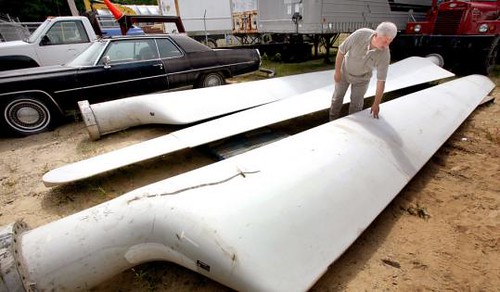
A Boston Globe article, Where turbines wind up to get their second wind, tells the story of a new twist on recycling. A company in Plymouth, Massachusetts, reburbishes aging wind turbines, repairing and replacing bearing, gear boxes, and generators, as required, to meet the growing need for wind power.

Brian D. Kuhn, the cofounder of Aeronautica, aims for the mid-level market, a niche that has significant potential for growth.

"The nice thing about this midscale market that we are concentrating on is these are not huge machines," said Kuhn, who hopes his company will be able to supply turbines to power schools, homes, or even supermarkets. Already, he says, several people with local projects in the works have called seeking equipment.


With backlogs on new wind turbines hindering deployments, Kuhn has built a business around the increasing popularity of wind as an energy source.

Wednesday, September 10, 2008

Playing Russian Roulette with the Planet

xNASA photo

In an effort to explore the forces that created the universe, scientists at CERN started operation of the Large Hadron Collider (LHC) today, despite concerns from some physicists and cosmologists that the experiments conducted in the LHC could cause reactions leading to the destruction of the planet.

Cosmologist Luis Sancho, who was initially behind the project, commented in Harpers:

Unfortunately, theoretical calculations show that the LHC could produce two kinds of dark matter—black holes and strange, ultradense quark matter—that are extremely dangerous, as both have been theoretically proven to swallow in a chain reaction the entirety of Earth. Thus, a cosmological bomb billions of times more powerful than the atomic bomb might be created at the European Organization for Nuclear Research.

The exact probability of a runaway reaction that converts Earth into dark matter is unknown. The minimal risk as calculated by CERN allows for a 1 to 10 percent chance of extinguishing Earth. In the insurance business, a potential catastrophe’s “death toll” is calculated by multiplying the number of possible victims by the probability that the event will occur. A similar calculation (6,000,000,000 x 1–10%) shows that the LHC experiment would be, technically, the largest holocaust in history. It would also be the biggest environmental crime in history, far more harmful than global warming, as it would mean the destruction of all life-forms on the planet. Since the production of dark matter is neither necessary for the advancement of science nor safe for mankind, the LHC should be forbidden to operate. As we close Chernobyl-like plants for security reasons and forbid the reproduction of the Ebola virus in an open environment (though some specialized virologists would like to study it for research purposes), so should we forbid the reproduction of free, uncontrolled dark matter, even if its theorists would like to study it at CERN. The production of dark matter will not be a “new discovery,” nor will it advance the study of physics. Furthermore, CERN’s researchers will not be awarded a Nobel Prize—the ultimate goal of all experimentalists—if Earth is consumed.


The LHC started without incident today, leading some wag at The Independent to proclaim, You're reading this, so the world hasn't ended.... Of course, the initial startup of the particle accelerator only involves a stream of sub-atomic particles moving in a single direction through the 27-kilometer circular tunnel. The particle collisions begin when they launch a stream in the opposite direction and those collisions are expected to briefly reproduce conditions that existed when the universe was conceived.

Efforts to halt the operation of the LHC through lawsuits until safety concerns are addressed have so far been unsuccessful. The Citizens Against The Large Hadron Collider Web site states:

Some experts fear that the risk of operating the LHC disproportionately outweighs anything science might gain from this experiment. It is not possible to know what the outcome of the experiment will be, but even CERN (the European Organization for Nuclear Research) scientists concede that there is a real possibility of creating destructive theoretical anomalies such as miniature black holes, strangelets and deSitter space transitions. These events have the potential to fundamentally alter matter and destroy our planet.


I wish I could get the image out of my head of a band of arrogant children poking at a hornet's nest with a stick to see what might happen. I'm not persuaded by the reassurances of the career-minded scientists at CERN who routinely dismiss critics at Luddites and yet don't really know what will happen and what the ultimate outcome will be when the particle streams collide in the LHC. That's why it's called an experiment.

Monday, September 08, 2008

Using Wind to Power Cars

electric-car_drum

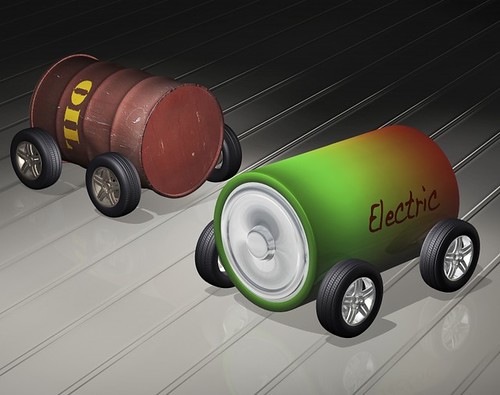
Lester Brown calls T. Boone Pickens to task for pushing natural gas as a vehicle fuel when using wind to recharge electric cars is a much more efficient process (and far easier to implement).

Brown gives Pickens credit for the wind power side of his argument in an opinion piece for The Capital Times, but sees no sense in the natural gas advocacy. In this piece, he asks:

Why not use the wind-generated electricity to power cars directly? Natural gas is still a fossil fuel that emits climate-changing gases when burned.

Plug-in cars are here, nearly ready to market. We just need to put wind in the driver's seat. Several major auto manufacturers, including GM, Ford, Toyota and Nissan, are producing plug-in hybrids. Both Toyota and GM are committed to marketing plug-in hybrids in 2010. Toyota might even try to deliver a plug-in version of its Prius gas-electric hybrid, the bestseller whose U.S. sales match those of all other hybrids combined, next year.

GM is in the game, too, with its Chevrolet Volt. This plug-in car is essentially an electric car with an auxiliary gasoline engine that generates electricity to recharge the batteries when needed. It boasts an all-electric range of 40 miles, more than adequate for most daily driving. GM reports that under typical driving conditions, the Volt averages 151 miles per gallon.


Brown goes on to say:

This new car technology is matched by new wind-turbine technology, setting the stage for an automotive-fuel economy powered largely by cheap wind energy. The Energy Department notes that North Dakota, Kansas and Texas alone have enough wind energy to easily satisfy national electricity needs. To actually put wind power on the road, of course, we would have to tap the wind resources in nearly all the states, plus those that are off-shore, which the department says can meet 70 percent of national electricity needs.


Who is right? I'm inclined to cast my vote in favor of Occam's Razor, or, as it is often paraphrased: All other things being equal, the simplest solution is the best. Wind-powered plug-in hybrids appear to be the simplest solution.

Sunday, August 31, 2008

No Such Thing As Clean Coal

There is no such thing as "clean coal", environmental lawyer Robert F. Kennedy Jr. stated in an interview with the Real News Network. His remarks followed a panel presentation on clean coal that included Dr. Hansen, the NASA scientist who has been warning about the dangers of global warming for a number of years. The consensus is clear and direct: coal is dirty and destructive.


Tuesday, August 19, 2008

Solar Energy Scales to New Levels

solar_in_CA

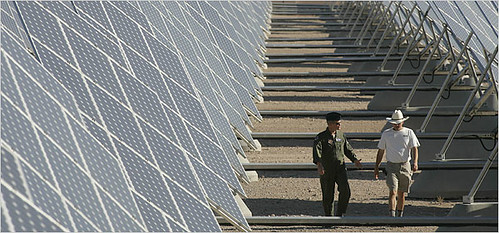
The 14-megawatt solar power installation (shown in the photo) that operates at Nellis Air Force Base in Nevada is about to be upstaged by a planned installation in California with an 800-megawatt capacity.

As the New York Times reports in Two Large Solar Plants Planned in California, the two photovoltaic installations, now being planned for central California, will produce power at a scale equivalent to a small nuclear power plant when the sun is shining brightly. The scale of this project is a clear indication that solar power has reached a new milestone. Pacific Gas & Electric will purchase the power from the two companies behind the installations: Optisolar and SunPower Corporation.

The companies said they were forbidden by contract terms to talk about price, and a spokeswoman for Pacific Gas & Electric said her company was trying to obtain the best possible deal for ratepayers by not telling other suppliers of renewable energy what it was willing to pay.

But all three companies said the costs would be much lower than photovoltaic installations of the past.


To some degree, these two installations are driven by recent mandates legislated in California, requiring energy producers to reach a level of 20 percent renewables by 2010. But, they also serve as a proof-of-concept that solar can generate power at a vastly larger scale than in the past using the latest technologies.


Tuesday, August 05, 2008

Reviving the Lost Arts: Fuel-Sipping Microcars

Avolette Tourisme 1956

The classic expression, "Necessity is the mother of invention", was proven beyond doubt in post-WWII Europe where the severe fuel shortages inspired automakers to create a variety of microcars. Often capable of hitting 70mph and traveling 90 miles on a gallon of fuel, these fuel-efficient wonders were manufactured in volume--perhaps 250,000 were produced in the years following the war.

The auto in the photo, a 1956 Avolette Tourisme, is part of a microcar collection owned by Bruce Weiner (who owes his fortune to Dubble Bubble gum). An entertaining piece by Bo Emerson in the Atlanta Car News talks about Weiner's obsession with these vehicles and charts the history of microcars.

Microcars were created out of necessity. Not only was gasoline at a premium, but manufacturers were short of money and materials. Messerschmitt was banned from building fighter planes and turned out sewing machines and refrigerators.

Entrepreneurs such as Fritz Fend (builder of the F.M.R.), created small shops, then collaborated with larger manufacturers. (Fend built thousands of vehicles in the Messerschmitt factories.) Some microcars were little more than enclosed, three-wheeled motorcycles.

The microcar craze lasted through the mid-1960s; by then European fortunes had risen, and customers demanded cars that could seat a family comfortably.


We had practical electric cars in the early 1900's, as well, phased out as our oil addiction grew by leaps and bounds. Perhaps it's time to revive some of these lost arts and build a new generation of microcars and electric vehicles--the necessity is cleary at hand.

Saturday, August 02, 2008

Storing Solar Energy the Way Plants Do

oxygen-nocera-enlarged

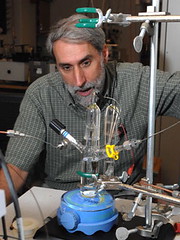
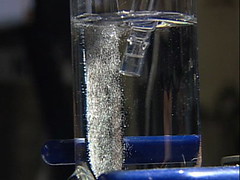
One of the chief complaints about the practicality of solar energy has been: what do you do when the sun isn't shining? MIT researchers have come up with an answer: using a technique similar to that used by plants during photosynthesis. The development of a new catalyst to produce oxygen when an electrical current is passed through water, working in combination with another catalyst that produces hydrogen gas, becomes a powerful mechanism for charging fuel cells. This stored energy can be released as needed, a virtually carbon-free source of electricity that is available day or night.

oxygen-bubbles-enlarged

As quoted in an article for the MIT News by Anne Trafton, Daniel Nocera, the Henry Dreyfus Professor of Energy at MIT, who has co-authored a paper on this discovery for the July 31, 2008 issue of Science, sees this as a landmark advance in energy production.

"This is just the beginning," said Nocera, principal investigator for the Solar Revolution Project funded by the Chesonis Family Foundation and co-Director of the Eni-MIT Solar Frontiers Center. "The scientific community is really going to run with this."

Nocera hopes that within 10 years, homeowners will be able to power their homes in daylight through photovoltaic cells, while using excess solar energy to produce hydrogen and oxygen to power their own household fuel cell. Electricity-by-wire from a central source could be a thing of the past.


Nocera also points out that the amount of sunlight that strikes the Earth in one hour is sufficient to supply the energy needs of the entire planet for a year.

In a video post on the MIT site, Nocera talks more about the potential of this new process.


Sunday, July 27, 2008

Electric Car Infrastructure

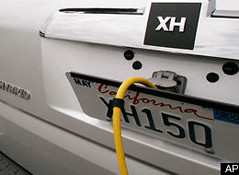
electric_car_plugin

The day is fast approaching when electric cars will be tooling around our city streets and neighborhoods, driven by people other than well-heeled celebrities or devoted hobbyists. As GM and a slate of other automobile manufacturers ready their first serious electric cars for the market, thoughts naturally turn toward the state of the infrastructure for dealing with these electricity sipping vehicles.

Joel Makower in Electric Cars: Where Will the Infrastructure Come From? grapples with some of the issues that are quickly moving from the theoretical realm to the practical.

In reality, the GM-utility conversation isn't entirely new. It began in January, at a Vehicle Electrification Workshop held at GM's research center in Warren, Michigan. I had the privilege of attending the meeting, which was facilitated by my colleagues at the sustainability strategy firm GreenOrder. The meeting included more than two dozen utility executives, including a team from the Electric Power Research Institute, the industry-funded consortium that served as the co-convener of the meeting.

It was an eye-opener, to say the least. It turns out that building the infrastructure for the plug-in electric vehicle isn't simply a matter of, "Here's a plug, here's a socket. End of story."

First of all, not everyone has a socket — a secure place to park their car and recharge it. Those living in apartment buildings, for example, lack this ability. Even where a plug exists, it may not have sufficient amperage to handle the load. (I'm a good example: I have a socket in my garage, but it's on the same circuit as my bedroom. If you plug in a power-hungry appliance in the garage, TiVo gets grumpy.)

But that's the least of it. Building the plug-in infrastructure involves a mind-numbing array of technical challenges.


Makover goes on to talk about connector compatibility, outlet access, vehicle-to-grid considerations, and other topics that make it clear that there is more to this transition away from the petrol pump than just hopping in an electric vehicle and driving away. Now is the time to start setting the standards and creating the infrastructure.

Thursday, July 24, 2008

Fighting Goliath: A Documentary About Coal Plant Battles in Texas


Conventional coal-fired power plants represent one of the most serious threats to human health and a major cause of global warming. This documentary, posted on SnagFilms, provides a revealing look at how a group of mayors, farmers, and ranchers fought a company planning to construct 18 of these power plants in Texas.

Sunday, July 20, 2008

Karoshi and Other Prius Stories

toyo_factory

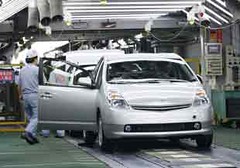
"Karoshi", a term used by Japanese workers that translates to "overworked to death" was the fate of 30-year old Kenichi Uchino, who collapsed and died at the Prius plant in "Toyota City", Japan. The court in Nagoya ruled the cause of death as exhaustion and noted that in the month leading to his death, Uchino had worked as much as 155 hours overtime, much of it unpaid.

This story and other unsettling details included in a report by the National Labor Committee in New York (NLC) casts a shadow on the labor practices of Toyota, the world's largest automobile manufacturer.

Paul Abowd, who picked up the story for In These Times, noted:

In its 65-page report released in June, NLC includes first-hand testimony of factory conditions in “Toyota City,” outside of Nagoya, Japan — less than 200 miles southwest of Tokyo — where the largest auto company in the world employs some 70,000 people.

The report alleges that Toyota exploits guest workers, mostly shipped in from China and Vietnam. According to the NLC, these workers are “stripped of their passports and often forced to work — including at subcontract plants supplying Toyota — 16 hours a day, seven days a week, while being paid less than half the legal minimum wage.” Workers are forced to live in company dormitories and deported for complaining about poor treatment, the report finds.


Both Abowd and the NLC recognized that Toyota's position in the auto industry hasn't been gained by a multitude of bad practices, but a growing trend toward undercutting the rights of the workforce by systematically lowering wages and introducing harsh work situations for temporary workers is steadily degrading the labor situation worldwide. Even in the U.S., where a middle class was born from comfortable automobile manufacturing jobs, Toyota's temporary worker practices are raising eyebrows.

In a rebuttal to the NLC report, Toyota responded:

Toyota is committed to being a good corporate citizen to all of our stakeholders, including our employees, partners, suppliers and customers. The NLC report contains numerous inaccuracies that present a false and misleading picture of our company. Contrary to the report’s allegations, Toyota respects its employees and honors the basic human rights of the people involved in our business. We comply with all applicable local laws and regulations wherever we operate while providing fair compensation and benefits.


However, many of the specific allegations in the NLC report went unanswered. We hope that Toyota takes its corporate responsibility seriously and addresses these labor issues in a transparent manner. Anyone driving around in a "green" Prius manufactured under questionable conditions should take Toyota to task and demand accountability and fairness for the way workers are treated.

Monday, July 14, 2008

Europe Shows How to Save Energy


vélo sans mains
Originally uploaded by yeuxrouge


With a surfeit of natural resources and an attitude that often views prodigious consumption as a virtue, the United States has lagged behind Europe for many years in terms of energy efficiency. As oil supplies dwindle and SUVs grow rust in the back corners of car lots, the message is finally getting through that our habits need changing and the kinds of changes needed can be seen in examples from Europe, where transportation, heating, cooling, and people-powered vehicles are dramatically different than stateside.


Writing for the Christian Science Monitor, Jerry Lanson explains the ways in which Energy-addicted U.S. can learn a lot from Europe. Among those ways, easy access to bicycles in the cities makes a sizable difference in traffic:

Throughout the city, residents and guests can grab a bike at one location, compliments of what seems a simple credit-card prompted trigger, and return it to any of dozens of other locations. The first half-hour, the instructions noted, is free. Each evening we watched as the streets filled with young and often fashionable bike riders, as likely pedaling in high heels and dress slacks as in jeans and sandals.

None of these measures, of course, have taken the sting out of gas prices twice as high in much of Europe as what Americans are paying for at the pump today. But perhaps if Americans, who still use more energy per person than any country in the world, took note and took action to follow suit, prices here and there might at least stabilize.


Lanson sums up the issue neatly at the end of this article:

So as we grouse at the president, Congress, the oil companies and just about anyone else paying too little heed to our growing pain, perhaps Americans should remember that conservation can – and should – begin both in our homes and in our towns.

Let's think globally, then act locally. Our European friends have been doing that for a long time.

Sunday, July 13, 2008

Beyond the Hype, Solar Power Advances


small solar collectors in a line
Originally uploaded by Kel Patolog


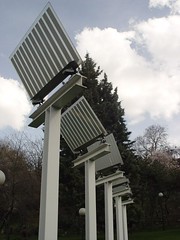
The convergence of technology advances and rising fossil fuel prices is bringing the potential of solar power into sharp focus, both literally and figuratively. Discoveries from researchers at MIT promise to boost the efficiency of solar panels by concentrating the sun's rays, a measure that will help bring down the cost of panels considerably.


In a Boston Globe article, Innovation fuels solar power drive, journalist Carolyn Y. Johnson writes of the MIT study:

The work by Mapel and others could potentially do both, by using a simple trick that makes more efficient use of sunlight and uses fewer costly solar cells.

Solar cells are made from different materials that each operate most efficiently when using light from a narrow band of wavelengths. By filtering the light through a pane of glass coated with dye, Mapel and his colleagues have been able to direct some light to solar cells that can use it most efficiently. Those cells are placed on the edge of the pane, requiring far fewer solar cells than if they were placed along the surface as on conventional panels.

The remaining light passes through the pane and, if placed on a conventional solar panel, can be converted to electricity.

The researchers found that their setup increased the efficiency of traditional panels by about 20 percent, but they believe that with a little more tweaking, they can boost that to 50 percent.


Solar power, by its nature, presents a different perspective on solving our individual and community power needs. Microgeneration technologies are gaining favor worldwide and given the slow response by many governments to dealing with CO2 reduction, many businesses, individuals, and communities are taking the initiative to deploy their own power generation systems.

Sunday, July 06, 2008

Japan's Many Examples of Energy Efficiency

japan_nytimes

One smart solution to our energy problems is to make due with less. Since the early 1970's, Japan, the world's second largest economy, has become skilled at that practice, adapting to the fact the country has a small land area and few natural resources. This hasn't stopped them from applying innovative energy saving techniques, particularly in the manufacturing sector, as discussed in a New York Times article, Japan Sees a Chance to Promote Its Energy-Frugal Ways. Journalist Martin Fackler noted:

According to the International Energy Agency, based in Paris, Japan consumed half as much energy per dollar worth of economic activity as the European Union or the United States, and one-eighth as much as China and India in 2005. While the country is known for green products like hybrid cars, most of its efficiency gains have been in less eye-catching areas, for example, in manufacturing.

Corporate Japan has managed to keep its overall annual energy consumption unchanged at the equivalent of a little more than a billion barrels of oil since the early 1970s, according to Economy Ministry data. It was able to maintain that level even as the economy doubled in size during the country’s boom years of the 1970s and ’80s.


The photo at the top of this post, by Ko Sasaki for The New York Times, shows a view through a window looking onto a commercial complex in Chiba, Japan, that uses transparent solar panels on window glass to generate power.